 Tool
Toggl Track vs Clockify: which fits a small team
Clockify wins on our rubric, and the margin is almost entirely money. At the annual rates read on October 12, 2026, ten seats cost $478.80 to $1,438.80 a year on Clockify and $1,080 to $1,920 a year on Toggl Track, and the cheaper product ships invoicing and timesheet approvals at its second rung while the dearer one holds approvals until its top published tier. Toggl Track wins two things that matter to some buyers more than the bill: it refuses to build screenshots or silent monitoring, which removes the hardest conversation in any tracker rollout, and it carries capacity planning that Clockify does not attempt. Both grades are documentation reviews; no first-hand testing was run and none is claimed.
 4.3Clockify
 4.0Toggl Track
The short answer
Two sentences, then the evidence.
- Clockify is best for a team whose constraint is budget and whose output is an invoice, an approval or a payroll figure: billable rates at $3.99 per seat per month billed annually, invoicing and approvals at $5.49, per the pricing page read October 12, 2026
- Toggl Track is best for a team whose constraint is adoption and whose output is project profitability: no screenshots and no silent monitoring, plus labor costs, fixed fee projects and approvals together at $16 per user per month billed annually
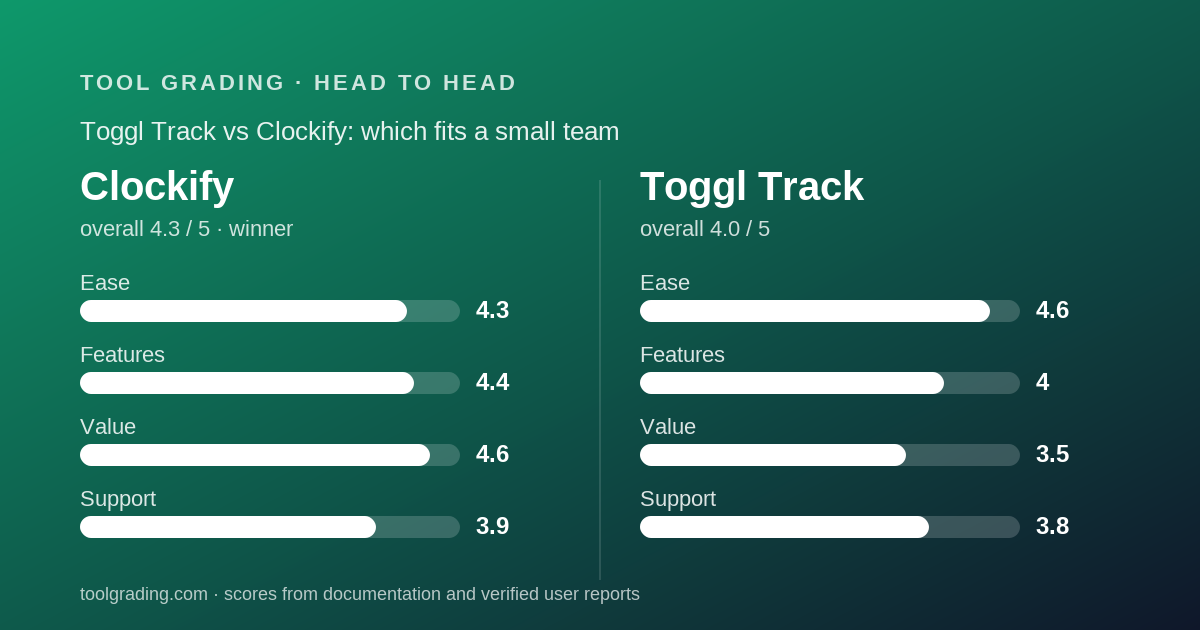
The overall rubric totals are 17.2 for Clockify across ease 4.3, features 4.4, value 4.6 and support 3.9, against 15.9 for Toggl Track across ease 4.6, features 4.0, value 3.5 and support 3.8.
Toggl Track holds the single highest sub-score in the comparison, 4.6 for ease. Clockify takes the total because it wins three of the four pillars. Our page on how the Tool Grading rubric works explains why no pillar is weighted above another.
The numbers side by side, read on the same day
Every figure below was read from the two vendors' own pricing pages on October 12, 2026. Where a vendor does not publish a figure, that is stated rather than estimated.
- Entry paid rate, annual billing: Clockify US$3.99 per seat per month; Toggl Track $9 per user per month
- Entry paid rate, monthly billing: Clockify US$4.99; Toggl Track $12
- Top published rate, annual billing: Clockify US$11.99 at ENTERPRISE; Toggl Track $16 at Premium, with Enterprise listed as contact us
- Free tier: Clockify up to 5 users with a one-month reporting range; Toggl Track free for a limited number of users, with the number not published on the pricing page or the help-centre payment plans article
- Seat minimum: neither vendor publishes one
- Billable rates: Clockify at BASIC, US$3.99; Toggl Track at Starter, $9
- Invoicing: Clockify at STANDARD, US$5.49; Toggl Track does not list invoicing as a plan feature
- Timesheet approvals: Clockify at STANDARD, US$5.49; Toggl Track at Premium, $16
- Single sign-on: Clockify at ENTERPRISE, US$11.99; Toggl Track at Premium, $16
- Audit log: Clockify at ENTERPRISE; Toggl Track in the data compliance group, published as a Premium-level entry
- Screenshots or silent monitoring: Clockify sells activity monitoring and GPS at PRO, US$7.99; Toggl Track sells neither, by stated policy
- Capacity planning: Clockify offers scheduling and forecasting at PRO; Toggl Track sells Capacity Management as a $5 per user per month add-on
- Add-ons: Clockify publishes kiosk limited seats from US$0.79; Toggl Track publishes Time Off Pro at $2 and Capacity Management at $5
- Annual against monthly gap: Clockify US$1.00 to US$3.00 per seat per month; Toggl Track labels its annual saving as 33.3 percent
- Published support response time: neither vendor publishes one
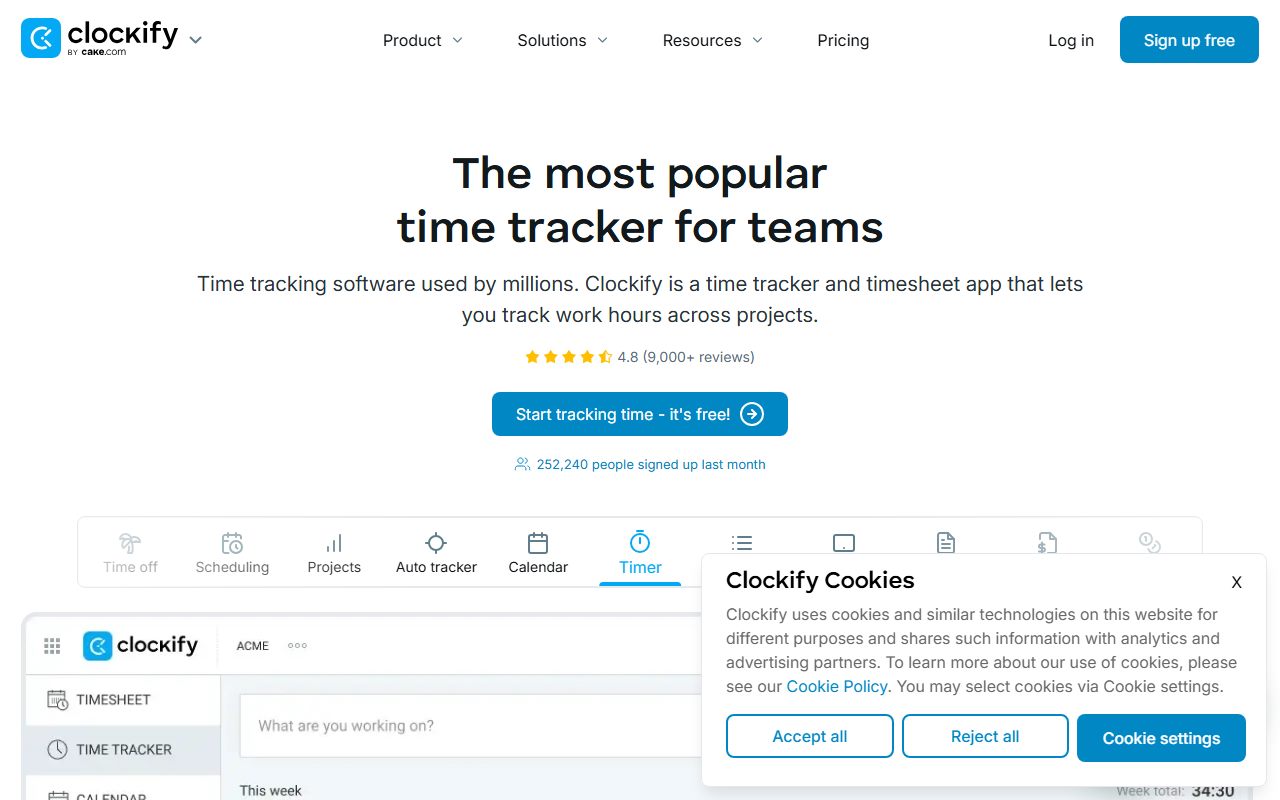
Clockify costs less at every team size, and the gap widens as features are added
Take ten people and the annual rates. The totals below are our arithmetic from the published per-seat figures, not vendor quotes.
On Clockify, ten seats cost $478.80 a year on BASIC, $658.80 on STANDARD, $958.80 on PRO and $1,438.80 on ENTERPRISE.
On Toggl Track, ten users cost $1,080 a year on Starter and $1,920 on Premium.
The cheapest useful configuration on each side is the comparison that matters. For a services firm the test is whether hours can become an invoice and whether a manager can approve a timesheet. Clockify meets that at STANDARD, $658.80 a year. Toggl Track meets the approval half at Premium, $1,920 a year, and does not list invoicing at all.
That is a difference of $1,261.20 a year for a ten-person team, or roughly three times the bill.
The gap narrows in exactly one scenario. A buyer who needs single sign-on pays Clockify's top rung, $1,438.80, because SSO is an ENTERPRISE feature there, against Toggl Track's $1,920 Premium which includes SSO. The margin falls to $481.20 a year. Our note on how to read a per-seat pricing page explains why the tier a feature sits on, not the entry rate, decides a bill.
Toggl Track is easier to roll out because of what it refuses to build
This is the one pillar Toggl Track wins, 4.6 against 4.3, and it is won on policy rather than on interface.
The Toggl pricing page carries a strip reading no screenshots, no surveillance, and the vendor describes an anti-surveillance stance beside its compliance claims. Desktop activity tracking exists, recording apps and windows used for more than ten seconds, but the plan comparison states the record stays private and the user decides which activity becomes a time entry.
Clockify, by contrast, sells activity monitoring, forced timers, kiosk photo capture and GPS tracking at PRO. None of that is forced on a buyer, but it exists in the product, and an employee reading the feature list will see it.
The practical consequence is a deployment one. A tracker that cannot take a screenshot does not need to be defended in a staff meeting, and adoption resistance is the most common reason a time tracking purchase quietly fails.
On mechanics the two are close. Both run web, desktop and mobile apps with timers, manual entry and a weekly grid. Clockify adds a kiosk mode for shared devices. Toggl Track adds boards, task estimates and a timeline view, so the plan and the record live together.
Clockify loses ease points for surface area: five tiers and well over a hundred toggles, with the settings a small team needs spread across them. Toggl Track loses ease points because capacity, the feature a manager most wants, is a separate add-on purchase.
Clockify is broader on money and administration; Toggl Track is deeper on planning
The features sub-scores are 4.4 for Clockify and 4.0 for Toggl Track, and the two products are not strong in the same places.
Clockify's breadth is commercial. Billable rates at BASIC, invoicing and approvals at STANDARD, then expenses, labor cost, profit, budgets, estimates, custom fields, multiple currencies and alerts at PRO. A firm can run the whole billing cycle without exporting. SSO, custom subdomain, SCIM provisioning and audit log exist at ENTERPRISE.
Toggl Track's depth is forward-looking. Draft projects model work not yet won. A timeline view groups by person, project or tag. Recurring projects carry budgets and roll unused hours over. Project dashboards compare actuals against estimates. Nothing in Clockify's documentation does the draft-project job.
Toggl Track also wins on reporting sophistication once Premium is reached, with labor costs, profitability and fixed fee projects in one tier.
The decisive asymmetry is invoicing. Clockify lists it as a plan feature at $5.49 per seat per month. Toggl Track does not list invoicing among its plan contents at all, which pushes an hourly business toward a second product. Teams in that position should look at the timesheet already inside their accounting software before buying either tracker.
Neither vendor publishes a support commitment, and both grades suffer for it
Support scores 3.9 for Clockify and 3.8 for Toggl Track, which is close, and both numbers are capped by the same omission.
Clockify publishes channels and no commitment. The contact page read October 12, 2026 lists email, chat and the telephone number +1-855-738-8741, with no response window. A dedicated success representative requires at least 120 seats on BASIC, 90 on STANDARD, 60 on PRO or 40 on ENTERPRISE, so a ten-person team never qualifies. One detail is recorded as read rather than as a pattern: the contact page was displaying a temporary technical issues notice that day.
Toggl Track publishes a help centre and holds personalised onboarding, a dedicated success manager and priority support for Enterprise, which is a contact-us tier with no published price. A small buyer therefore cannot see what paying more would buy.
One trust-claim problem belongs to Toggl Track alone. Its pricing page states ISO certification, SOC 2 Type 1 and 99.9 percent uptime in one block, and 99.99 percent uptime with SOC Type 2 and ISO 27001 in another, both read the same day. Those are different claims, and a buyer should ask for the report rather than trust the strip. Our note on what priority support actually means sets out why we grade published commitments and not reputations.
Documentation quality is a draw. Both vendors document plan contents, feature definitions and billing mechanics at article level rather than only in marketing copy, which is better than much of the wider software market manages.
The free tiers answer different questions, and one of them will not say how big it is
Clockify's free tier is capped and specified. Up to 5 users. A one-month reporting range. PDF-only export. The API allows 30 requests per hour against 50 requests per second on paid workspaces. Webhooks are capped at three against up to 100 per paid workspace. Tracking itself is unlimited.
Toggl Track's free tier is described on its pricing page as free for a limited number of users, and the help-centre article on payment plans repeats that phrasing without a number. We could not read the figure on either page. We are not saying the vendor has no limit or refuses to state one; we are saying a buyer cannot size the tier before signing up.
For a pilot, Clockify's cap is the better design because it is knowable. Five people can run timers, grids and this month's reports indefinitely and then decide.
For an hourly business neither free tier answers the real question, because billable rates are a paid feature on both sides. Our note on what free tiers are actually for treats that as the normal shape of a free tier rather than a complaint.
On billing cycles, Toggl Track's annual saving of 33.3 percent is the larger discount, while Clockify's monthly penalty of $1.00 to $3.00 per seat is the smaller absolute cost of staying flexible. Our note on annual against monthly SaaS billing covers when a small team should take the discount.
Choose Clockify if, choose Toggl Track if
The deciding questions are narrow, and both products are defensible answers to different ones.
- Choose Clockify if the per-seat budget is the binding constraint, because every rung costs less than the rival's entry rate
- Choose Clockify if hours have to become an invoice, since invoicing is a published plan feature at US$5.49 per seat per month
- Choose Clockify if part of your workforce clocks in on a shared device, because kiosk seats start at US$0.79 per limited seat per month
- Choose Clockify if you want approvals without reaching a top tier
- Choose Toggl Track if staff resistance to monitoring is a real adoption risk and you want a product that cannot take screenshots
- Choose Toggl Track if you need capacity planning, draft projects and a timeline alongside tracking, and have budgeted the $5 per user per month add-on
- Choose Toggl Track if single sign-on matters and you would rather pay $16 per user per month than a rival's top rung for it
- Choose Toggl Track if project profitability, not the invoice, is the output you need
If neither answer is obviously yours, the deciding factor is usually what happens to the hours after they are recorded. Hours that become invoices and payroll point to Clockify. Hours that become margin analysis and next quarter's capacity point to Toggl Track.
Teams making this decision as part of a wider stack review should also read our best tools for a ten-person remote team guide, which places both products beside the project, communication and finance tools they will have to connect to, and our grade of Asana if the project tool's own tracking might make a separate tracker unnecessary.
Bottom line
Clockify wins this comparison 17.2 to 15.9 because it is cheaper at every tier, it puts invoicing and approvals at its second rung, and it publishes its seat rule and free-tier caps in numbers.
Toggl Track loses on the rubric and remains the right purchase for a specific buyer: a professional team that will not accept a monitoring product, needs planning in the same tool as tracking, and can absorb roughly three times the per-seat cost.
Both grades rest on vendor documentation read on October 12, 2026 and both are documentation reviews. If either vendor changes a tier, the sub-scores change with it.
Frequently asked
Which is cheaper for a ten-person team?
Clockify, at every comparable tier. Using annual rates read October 12, 2026, ten seats cost $478.80 to $1,438.80 a year on Clockify against $1,080 to $1,920 on Toggl Track. The cheapest configuration with invoicing and approvals is $658.80 on Clockify, by our arithmetic.
Does either product take screenshots?
Clockify sells activity monitoring, forced timers, kiosk photo capture and GPS tracking at its PRO tier. Toggl Track sells none of that and states on its pricing page that there are no screenshots and no surveillance. If evidence capture is your requirement, neither of these two is the deepest option graded on this site.
Can I switch from Toggl Track to Clockify?
Clockify documents import of time entries and users, which is the mechanism a migration needs, and its free tier for five users lets a team trial the destination before committing. Neither vendor publishes a guaranteed migration path, so treat an export of historical entries as the first step.
Which one has invoicing?
Clockify, at STANDARD, US$5.49 per seat per month billed annually. Toggl Track does not list invoicing among its published plan contents, so an hourly business on Toggl Track will need accounting or invoicing software alongside it.
Which free plan is bigger?
Unknown, and that is the point. Clockify publishes up to 5 users with a one-month reporting range. Toggl Track says free for a limited number of users on its pricing page and repeats the phrase without a figure in its help centre. A cap you can read beats a cap you cannot.
Visit Clockify
We have no affiliate relationship with this vendor. Link goes to the official site.
Visit Toggl Track
We have no affiliate relationship with this vendor. Link goes to the official site.