 Tool
Tool
Gusto
US payroll with a base fee plus a per-person fee, where the tier you need is decided by how many states you pay people in.
Scored on the published rubric, from documentation, pricing and verified user reports.
Best for: US businesses of five to fifty W-2 employees and domestic contractors who want full-service payroll with tax filing, benefits administration and light HR without a dedicated HR person.
Verdict
Gusto is the clearest-priced full-service payroll product for a US small business, and its pricing page states the structure in one line: a monthly base fee plus a per-person fee, with three tiers whose main dividing line is whether you pay people in one state or several. Per the page read October 7, 2026, every tier includes unlimited payroll runs, federal and state tax filings and payments, direct deposit, and an employee app; the Plus tier adds multi-state payroll, time tracking and next-day pay; Premium adds a named support contact, HR guidance and compliance tooling. For a business with employees in one state and no HR department, the Simple tier does the entire job. The costs are specific. The per-person fee doubles from Simple to Plus and nearly doubles again to Premium, so a growing or multi-state team pays steeply for the step up. Priority support is a paid add-on below Premium, and verified user reports describe standard support as the weakest part of the package. Benefits are brokered through Gusto and are strongest in the states where its carriers operate. This grade comes from vendor documentation, pricing structure and verified user reports, against the published rubric; it is a documentation review, no first-hand testing was run and none is claimed.
Visit Gusto
We have no affiliate relationship with this vendor. Link goes to the official site.
Where it is strong
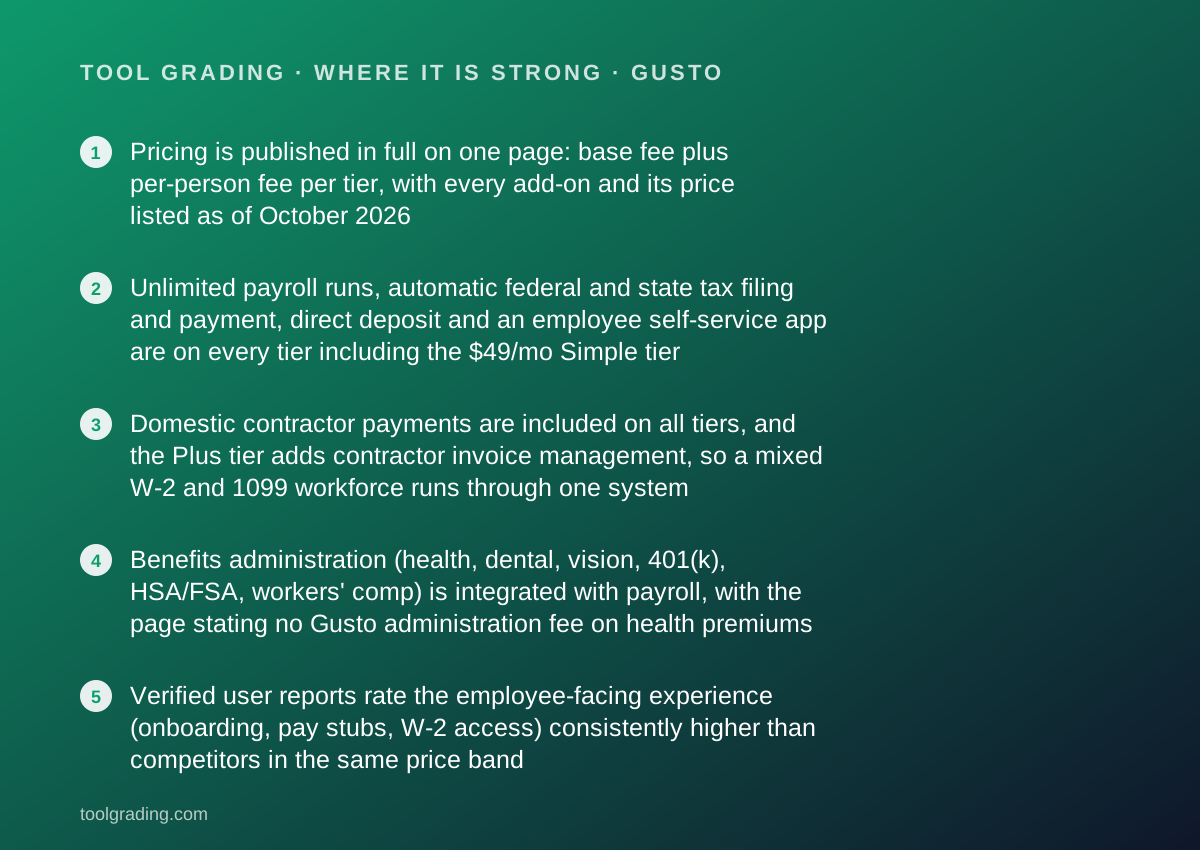
- Pricing is published in full on one page: base fee plus per-person fee per tier, with every add-on and its price listed as of October 2026
- Unlimited payroll runs, automatic federal and state tax filing and payment, direct deposit and an employee self-service app are on every tier including the $49/mo Simple tier
- Domestic contractor payments are included on all tiers, and the Plus tier adds contractor invoice management, so a mixed W-2 and 1099 workforce runs through one system
- Benefits administration (health, dental, vision, 401(k), HSA/FSA, workers' comp) is integrated with payroll, with the page stating no Gusto administration fee on health premiums
- Verified user reports rate the employee-facing experience (onboarding, pay stubs, W-2 access) consistently higher than competitors in the same price band
Where it falls short
- The per-person fee steps from $6 to $12 to $22 across tiers, so a multi-state team is pushed from Simple to Plus and pays double per head for the privilege
- Priority Support is a paid add-on at $30/mo plus $3 per person on Simple and Plus; verified user reports describe standard support as slow during peak periods such as quarter and year end
- Time tracking is included only from Plus; on Simple it is a $6 per person add-on, which narrows the gap between tiers for hourly workforces
- Health insurance is brokered through Gusto's own insurance arm and plan availability varies by state per the vendor's disclaimer, so coverage is not uniform nationally
- Global contractor payments are an add-on with a per-payment fee and foreign exchange rates that vary, so it is not a substitute for a dedicated international platform
What the product actually is
Gusto is a full-service US payroll processor with a benefits brokerage and a light HR layer attached. Full-service, in the vendor's documented meaning, is that Gusto calculates pay, withholds taxes, files the federal and state returns, makes the tax payments and issues year-end forms (W-2s and 1099s) on the employer's behalf. The employer's job reduces to approving a payroll, or to nothing at all if the AutoPilot feature is switched on for salaried staff.
The core data model is a company, its work locations and tax registrations, and its people, each of whom is either a W-2 employee or a domestic contractor with a pay rate, a schedule, deductions and benefits elections. Payroll runs are events against that model; everything else (time tracking, PTO, expenses, benefits, documents) feeds into or reads from it. The employee has their own login and app, which is where onboarding paperwork, pay stubs, tax forms and benefits enrolment happen, and which is the part of the product most often praised in verified user reports.
The second structural fact is that the HR layer is deliberately light. Gusto is not an HRIS in the sense of a performance, learning and workforce-planning system. It is payroll with hiring and onboarding, documents, basic PTO policies, and, on the Premium tier, HR guidance and compliance tooling. A business that needs more than that connects Gusto to a dedicated HR system through the app directory.
The third fact, and the one that decides the tier, is geography. Per the pricing page read October 7, 2026, the Simple tier runs payroll in one state; multi-state payroll is on Plus and above.
Who it is for, and who it is not
The best fit is a US business of roughly five to fifty people, with W-2 employees, perhaps some domestic contractors, no dedicated HR or payroll person, and an owner who wants payroll to be a monthly approval rather than a monthly project. Restaurants, clinics, agencies, trades, retail and early-stage startups fall here. The combination of automatic filings, benefits and an employee app covers the whole administrative surface of employing people at that scale.
It also fits businesses whose accounting is on QuickBooks Online, Xero or FreshBooks, all three of which either integrate with Gusto or, in Xero's case, resell it as their US payroll; the general-ledger sync is part of the standard product.
Three groups it fits less well. A business with employees outside the United States is outside Gusto's core; the global contractor payment add-on handles contractors in 120-plus countries per the page, but foreign employees are not supported, and a business with that need should read the Deel review. A business that needs a real HRIS with performance management and workforce planning will find the HR layer thin. And a very large or complex employer (unions, prevailing wage, complex certified payroll) is outside the product's documented scope.
How the pricing is structured
The figures below were read from the vendor's pricing page on October 7, 2026. The page is unusually explicit: three tiers, each with a monthly base fee and a per-person monthly fee, no contract, free setup, and the stated ability to switch or cancel at any time. No promotional rate was displayed on the tiers themselves.
The structure is base plus per-person. The base fee rises from $49 to $80 to $180 per month across Simple, Plus and Premium; the per-person fee rises from $6 to $12 to $22. The per-person fee is the variable that grows with the business, so the tier choice compounds with headcount in a way that a flat-fee product's does not.
The tiers divide by three things. Geography: Simple is single-state, Plus and above are multi-state. Speed: next-day pay is included from Plus, same-day and instant pay from Premium, and both are available as paid add-ons below those tiers. Support and HR: Premium includes a named account support contact, HR guidance and tools, and the Gusto Business Compliance tooling, all of which are add-ons or unavailable below it.
The add-on list is long and fully priced on the page, which is to the vendor's credit. The ones most likely to appear on a small-business bill: Priority Support at $30/mo plus $3 per person (Simple and Plus), Time and Attendance Plus at $6 per person (Simple), Next-Day pay at $15/mo plus $3 per person (Simple), state tax registration at a price that varies by state, and workers' compensation starting at $14/mo. Health, life and disability premiums are paid to carriers with no stated Gusto administration fee. A contractor-focused plan and an owner-only Solo plan are referenced on the page but their figures were not read for this entry.
- Simple: $49/mo plus $6 per person; single-state payroll, unlimited runs, tax filings, basic PTO (as of October 2026)
- Plus: $80/mo plus $12 per person; adds multi-state payroll, time tracking and scheduling, next-day pay, contractor invoice management, workforce cost reports
- Premium: $180/mo plus $22 per person; adds Premium Account Support, HR guidance, Gusto Business Compliance, same-day and instant pay, project costing, custom admin roles
- Priority Support add-on: $30/mo plus $3 per person (Simple and Plus); Time and Attendance Plus: $6 per person (Simple)
- Global contractor payments: $5 per payment to US bank accounts, FX varies; Gusto Business Compliance: $85/mo per state on annual contract (Simple and Plus)
Ease of use: what the score is built from
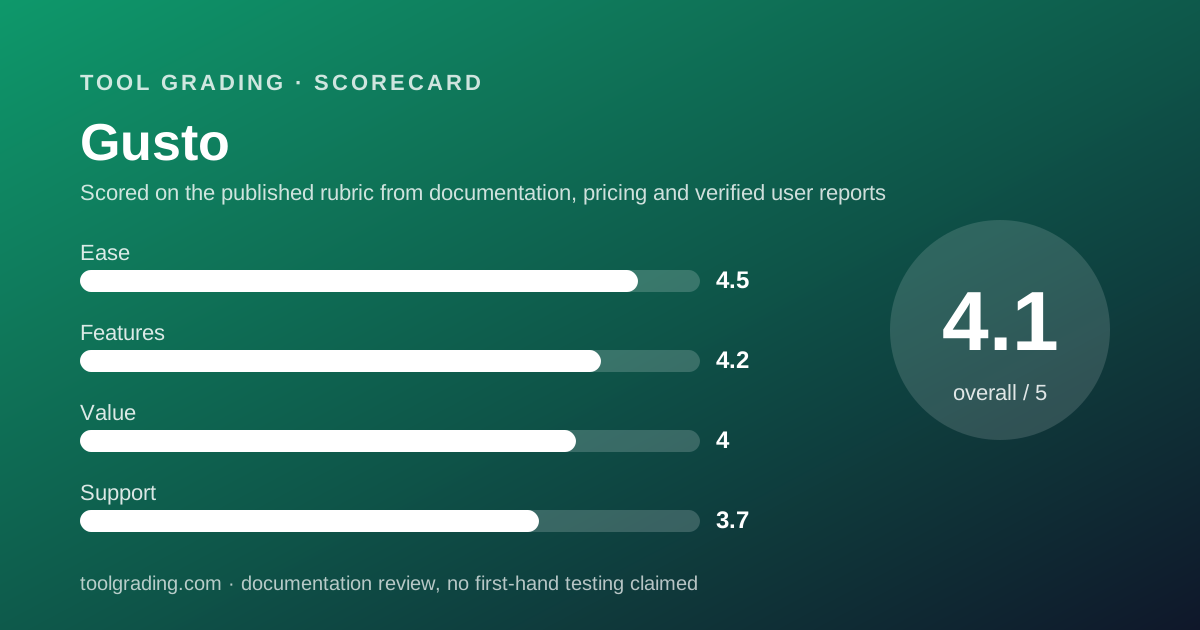
The ease sub-score of 4.5 reflects a product whose documented workflow is as short as payroll can be made, and whose employee-facing side removes the paperwork that normally lands on the employer.
The employer loop, per the documentation, is: add a person, who completes their own onboarding (tax forms, direct deposit, documents) through their login; set their pay and schedule; approve payroll on the scheduled day, or let AutoPilot approve it. Taxes, filings and payments happen without further action, and pay stubs and year-end forms reach the employee app. For a salaried team in one state, the monthly effort is close to zero after setup.
Setup is where the work sits, as with every payroll system, because historical payroll data, tax registrations and benefits elections have to be entered correctly before the first run. The help centre has a switching guide, and verified user reports describe the migration as manageable for a small team and tedious mid-year.
Two things lower the score. Multi-state employment introduces state tax registration, which the vendor sells as an add-on and which users describe as the first place the simple product becomes complicated. And time tracking on Simple is a paid module to configure, which is more setup than the headline suggests.
Feature depth: what the score is built from
The feature sub-score of 4.2 is built from a complete payroll core, an integrated benefits layer, and a deliberately light HR layer.
Payroll is complete for the target business. Unlimited runs, multiple pay rates and schedules, direct deposit or printed cheques, automatic federal and state filings and payments, year-end forms, domestic contractor payments, and an employer mobile app are on every tier per the pricing page. Plus adds contractor invoice upload, workforce cost reports and unlimited custom earning types; Premium adds unlimited custom admin roles and project-based costing. The documented support for tip wages, service charges and R&D tax credits (priced at 15% of identified credits) extends the core for hospitality and technology businesses.
Benefits are the second pillar and are integrated rather than referred out: health, dental and vision through licensed brokers with premiums as the only cost, 401(k) through integrations, HSA and FSA accounts at per-participant fees listed on the page, life and disability, and pay-as-you-go workers' compensation through a partner. The vendor's own disclaimer notes that plan availability varies by state.
The HR layer covers hiring and onboarding, documents, PTO policies, and, on Premium, HR guidance and compliance tracking. It is adequate for a small business without an HR person and thin for one with HR ambitions. What is outside scope: international employees, and anything resembling performance or talent management. The app directory covers both through partners.
Value at a realistic team size
Value is calculated here for a ten-person team, and Gusto's published pricing makes the arithmetic direct.
Ten W-2 employees in one state on Simple: $49 plus $60, or $109/mo, for full-service payroll with filings and an employee app. That is a strong figure for the category, and it is the reason the value sub-score is 4.0.
The same ten people across two states, or needing built-in time tracking, are on Plus: $80 plus $120, or $200/mo. The step is $91/mo, or 83%, for multi-state and time tracking, and the per-person fee doubling is what drives it. Premium for ten people is $180 plus $220, or $400/mo, and is justified mainly by the named support contact and compliance tooling, which a ten-person business rarely needs.
The add-ons move the Simple figure quickly. Simple plus Priority Support ($30 plus $30) and Time and Attendance Plus ($60) for ten people is $229/mo, which is more than Plus with both included. The practical rule from the vendor's own price list is that a Simple-tier business adding two add-ons should price Plus instead.
Against the category, Gusto's Simple and Plus tiers are competitive with the payroll add-ons sold by the accounting vendors reviewed on this site. Against a global platform such as Deel, Gusto is far cheaper per head for a US-only workforce and not comparable for an international one. Benefits premiums, workers' comp and state registration fees sit outside these figures.
Support and documentation
The support sub-score of 3.7 reflects strong self-service, a tiered assisted channel, and a verified-user pattern that is consistent enough to count.
The help centre, read on October 7, 2026, is organised by audience (employers and admins, employees and managers, accountant partners, contractors) and by topic (company setup, taxes and compliance, people, payroll, benefits, reports, app directory, tax credits, time and attendance), with video tutorials, an AI assistant and a switching guide. For a product whose main risk is misconfigured tax registration, the depth of the taxes and compliance section is appropriate.
Assisted support is tiered on the pricing page. All tiers list expert support in the comparison table; Premium includes a named Premium Account Support contact; Simple and Plus can buy Priority Support for prioritised phone and chat access at $30/mo plus $3 per person. The page does not publish support hours or response-time commitments, and no status page is linked from the pages read. The vendor displays a 4.6-star average across 4,137 Capterra reviews on the pricing page; that is a vendor-displayed figure and is noted as a claim.
Verified user reports describe the pattern familiar across this category: good documentation, responsive support for routine questions, and slow or inconsistent support during peak periods (quarter end, year end, tax notices). The existence of a paid priority tier is itself evidence that standard response is not always fast. This site does not measure response time and does not estimate it; the pattern is weighed as evidence and is why the support score sits below the ease and feature scores.
What verified users report
Across public review sites, the pattern for Gusto is stable.
The dominant positive is simplicity: payroll that runs itself, taxes filed without the owner thinking about them, and an interface a non-specialist can operate. The second positive is the employee experience: self-onboarding, the app, pay stubs and W-2s, and benefits enrolment without HR help. The third is transparent pricing, which users contrast with competitors that quote by sales call.
The dominant complaint is support, specifically wait times and the handling of tax notices and corrections, with year-end and W-2 correction issues named most often. The second complaint is price growth: the per-person fee at the Plus tier for a growing team, and the number of add-ons that a business ends up buying. The third is benefits availability and carrier choice in some states, which is consistent with the vendor's own disclaimer about state-by-state plan availability.
These reports are weighed as pattern rather than measurement and are not converted into a number. They explain why the ease score is the highest of the four and the support score the lowest.
Alternatives on this site
Deel is the alternative when any part of the workforce is outside the United States. It is priced per contractor or per employee at rates far above Gusto's per-person fee, because it is providing legal employment or compliance in other countries rather than processing a domestic payroll; for a US-only team it is the wrong tool, and for an international team Gusto is.
The three accounting products reviewed on this site each have a payroll path. Xero resells Gusto as its US payroll per its pricing page. FreshBooks sells its own payroll add-on and names Gusto among its integrations. QuickBooks Online sells payroll as a separate product whose pricing was not read for this review; a business already on QuickBooks should price that against Gusto.
Bottom line
Gusto is the payroll product to price first for a US business of five to fifty people with no payroll specialist. The pricing page read on October 7, 2026 states the whole structure, base fee plus per-person fee across three tiers, and the Simple tier at $49/mo plus $6 per person covers full-service payroll, tax filing and an employee app for a single-state team at a figure few competitors match.
The decision point is the Plus tier. Multi-state employment, built-in time tracking and next-day pay all live there, and the per-person fee doubles to reach it. A ten-person business in two states is at $200/mo rather than $109/mo, and should accept that figure as the real price rather than the Simple headline.
Two facts should steer some readers elsewhere. Standard support is the recurring complaint in verified user reports and the vendor sells a priority tier to address it; a business that cannot tolerate a slow answer on a tax notice should budget for that add-on or for Premium. And international employees are out of scope entirely. Check the current pricing page before buying; the figures here are a snapshot.
Visit Gusto
We have no affiliate relationship with this vendor. Link goes to the official site.