 Tool
Tool
Deel
A global employment platform priced per worker per month, where the product you buy depends on the legal relationship you want with each person.
Scored on the published rubric, from documentation, pricing and verified user reports.
Best for: Companies of five to fifty that employ or contract people in more than one country and need compliant contracts, payments and, where required, a local legal employer without opening entities.
Verdict
Deel is not one product but a set of legal relationships sold through one interface, and the pricing page read on October 7, 2026 makes that explicit: a contractor managed through Deel is $49 per month, a contractor employed by Deel on your behalf (Contractor of Record) is $325, an employee legally employed by Deel's entity in another country (Employer of Record) is $599, and a US employee under Deel's co-employment PEO is $125. Global payroll for your own entities is quoted rather than listed. The product's depth is real: the vendor cites EOR entities in 130-plus countries, compliance coverage in 150-plus, 24/7 support, and a legal team of 200-plus, and verified user reports corroborate that the contract, onboarding and payment workflows do what they say. The cost is that every figure is per head per month and the EOR figure in particular is a large multiple of a domestic payroll fee; a ten-person international team can easily exceed a domestic team's entire software budget. For a US-only business Deel is the wrong product and [Gusto](/review/gusto/) is the right one; for a business with people in three countries, Deel is the category leader by documentation and the price is the price of not opening three entities. This grade comes from vendor documentation, pricing structure and verified user reports, against the published rubric; it is a documentation review, no first-hand testing was run and none is claimed.
Visit Deel
We have no affiliate relationship with this vendor. Link goes to the official site.
Where it is strong
- One platform covers contractors, Employer of Record employees, US PEO employees, and payroll for your own entities, so a mixed global workforce has a single system of record
- Published per-worker pricing for contractors ($49/mo), Contractor of Record ($325/mo), EOR ($599/mo) and US PEO ($125/mo) as of October 2026, with no long-term contract per the page
- Vendor cites owned entities in 130-plus countries for EOR and compliance coverage in 150-plus, with contractor payments in 120-plus currencies
- Contractor workflow (localised contracts, classification checks, invoicing, tax-form collection, multi-currency payouts) is the most complete reviewed on this site
- Stated 24/7 support, SLA-backed managed payroll, and SOC 2 Type II and ISO 27001 certifications, which are the controls a finance lead will be asked about
Where it falls short
- Per-head pricing at $599 per EOR employee per month is a large fixed cost per hire; it is the price of avoiding a local entity, not a payroll fee, and should be modelled as such
- Global payroll for owned entities is not priced on the page; it is quote-based, which makes budgeting harder than for the listed products
- The product is built for cross-border employment; a US-only team pays for compliance infrastructure it does not use, and domestic payroll vendors are far cheaper per head
- Verified user reports describe variable quality across countries, because local benefits, terminations and notice periods depend on in-country partners and law, not on the software
- Contractor-of-Record and EOR relationships mean the worker is legally employed by Deel's entity, which some workers and some clients' procurement teams object to; this is structural, not a defect
What the product actually is
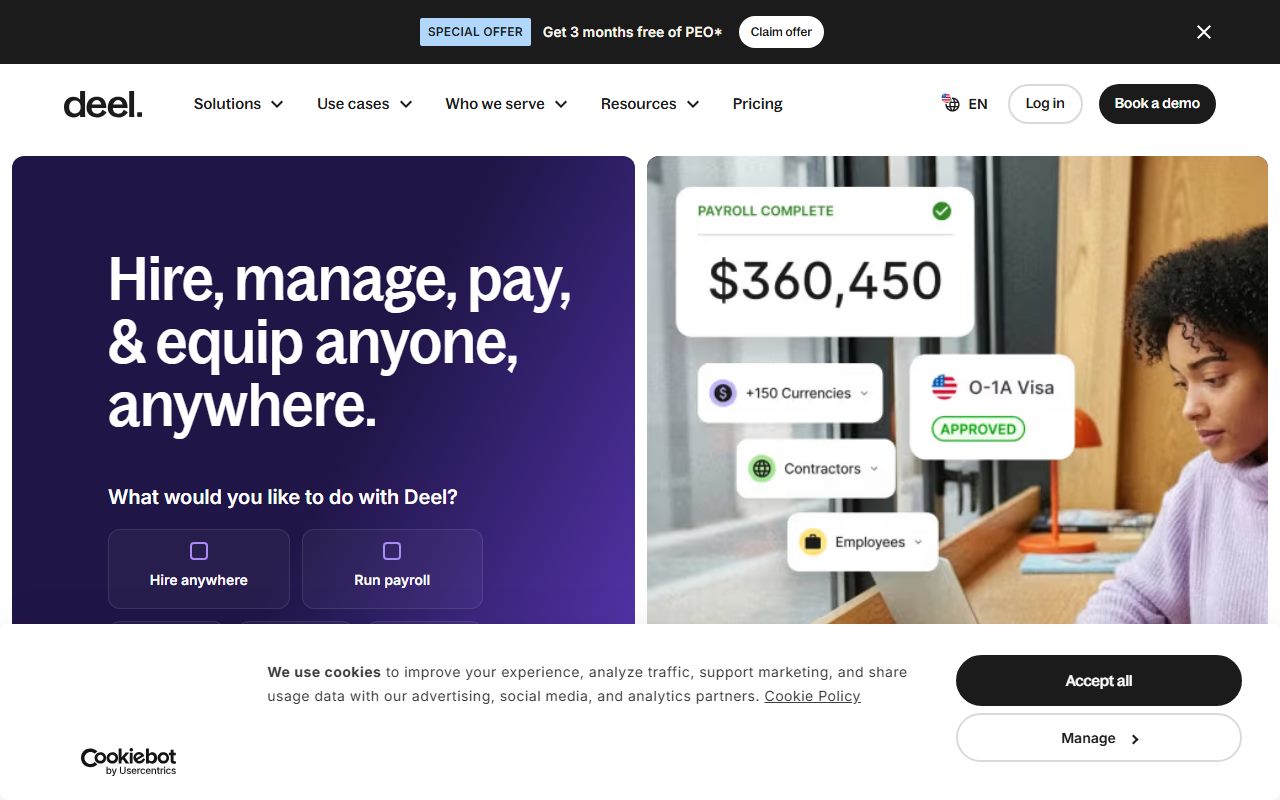
Deel is a platform for employing and paying people across borders, and the thing to understand first is that its products are legal structures rather than software features. The software is the same interface over each; what differs is who is legally the employer and what obligations that creates.
Per the pricing page read on October 7, 2026, there are four listed relationships. Contractor management: the worker is an independent contractor of your company, and Deel provides the localised contract, classification guidance, invoicing, tax-form collection and multi-currency payment. Contractor of Record: Deel's entity contracts with the worker and you contract with Deel, which moves the misclassification risk to Deel. Employer of Record (EOR): the worker is a full employee of Deel's local entity in their country, with local payroll, benefits and compliance handled by Deel, and you direct their work. US PEO: co-employment for US employees across all 50 states with benefits included. A fifth product, global payroll for companies that own their foreign entities, is offered as managed or customer-run and is quoted rather than listed. A sixth, talent sourcing, is listed at a per-worker rate.
The data model is therefore a company, its workers, and for each worker a relationship type, a country, a contract, a pay schedule and a currency. Everything else (onboarding, documents, time off, expenses, HR records) hangs off that. The product's centre of gravity is the compliant relationship and the payment.
So the evaluation question is not whether Deel is good HR software. It is whether your business has people in countries where it has no entity, and what it would otherwise cost to employ them.
Who it is for, and who it is not
The best fit is a company of roughly five to fifty people, often a startup or a remote-first services business, with contractors or employees in several countries and no entity in most of them. The alternative to Deel is either opening a foreign subsidiary (expensive and slow) or misclassifying an employee as a contractor (a legal risk the vendor's documentation is built to remove). For that business, the per-head fee is cheaper than the alternative.
It also fits a US company that wants PEO-style co-employment for its domestic staff and has or plans international hires, because the same system covers both.
Three groups it fits less well. A US-only business is paying for cross-border infrastructure it does not use; Gusto at $49/mo plus $6 per person on its Simple tier does that job for a fraction of the per-head cost. A company that already has entities in every country where it employs people needs global payroll, not EOR, and should request the quote-based product and compare it against local providers. And a business whose procurement or workers object to being employed by a third-party entity should understand that EOR is, by definition, that arrangement.
How the pricing is structured
The figures below were read from the vendor's pricing page on October 7, 2026. The page lists prices per worker per month for the listed products, states that no long-term contract is required, and lists no free tier for the products as read. Global payroll for owned entities is not priced on the page and is quoted.
The structure is per head per month, with the rate determined by the legal relationship rather than by features. The cheapest listed relationship is a managed contractor at $49 per contractor per month. Moving the legal relationship to Deel (Contractor of Record) raises it to $325. Full employment through Deel's foreign entity (EOR) is $599 per employee per month. US co-employment (PEO) is $125 per employee per month. Talent sourcing is $14 per worker per month.
The variables that move the bill are the number of workers and the relationship chosen for each, and the second is the one that surprises people. A team of ten with three EOR employees and seven contractors is a very different bill from ten EOR employees, and the choice between contractor and EOR is a legal question about the worker's role, not a budget preference.
Two things are not on the page and must be requested: global payroll pricing, and the local statutory benefits and employer contributions in each EOR country, which are passed through on top of the Deel fee. The $599 figure is Deel's fee; the all-in cost of an EOR employee is that fee plus the local employment cost.
- Hire Contractors: $49 per contractor per month; or Contractor of Record at $325 per contractor per month (as of October 2026)
- Hire Employees via EOR: $599 per employee per month, full legal employment in 130-plus countries per the page, plus local employment costs
- Hire Employees via US PEO: $125 per employee per month, co-employment across all 50 US states with benefits
- Find Talent: $14 per worker per month, job posting, screening and interview scheduling
- Global Payroll for owned entities: managed or customer-run; priced by quote, not listed on the page

Ease of use: what the score is built from
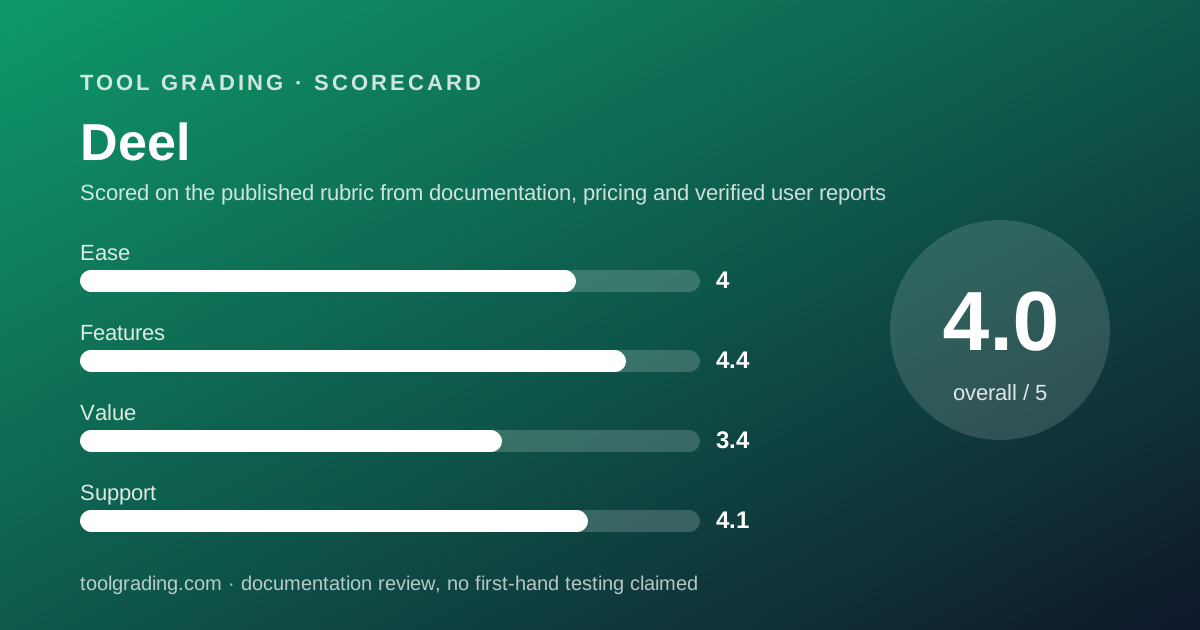
The ease sub-score of 4.0 reflects a product that makes a complicated thing (employing someone in another country) feel like a short form, while the complication itself remains real underneath.
The documented workflow for a contractor is: create a contract from a localised template, the contractor signs and uploads tax and identity documents, invoices are generated on schedule, you approve, and payment goes out in the contractor's currency. For an EOR employee, the vendor states onboarding can complete in as little as one day, with the local contract, benefits enrolment and payroll registration handled by Deel's entity. The worker gets their own login for documents, pay slips, time off and expenses.
The interface is consistently described in verified user reports as clean, and the contractor side in particular as quick for both parties. Integrations with HR and finance systems (the vendor names Workday, SAP, Oracle, Okta and BambooHR, among others) reduce double entry.
Where ease drops. The legal choice between contractor, Contractor of Record and EOR has to be made per worker and is a legal decision, however cleanly the software presents it. Country-specific rules on notice periods, probation and termination are surfaced in the platform but still have to be understood, and public user questions concentrate on offboarding. None of this is a software problem; all of it lands on the person using the software.
Feature depth: what the score is built from
The feature sub-score of 4.4 is the highest of the four and is carried by coverage rather than by any single feature.
Coverage is the product. The vendor cites EOR entities in 130-plus countries, compliance coverage in 150-plus, contractor payments in 120-plus currencies, and 200-plus legal experts maintaining the country rules. Verified user reports corroborate that the documented workflows (contracts, onboarding, payments, pay slips, tax forms) function across the countries users have tried, with the caveat about local variation noted under cons.
The contractor product is the most complete reviewed on this site: localised contract templates, classification assessment, document collection, automated invoicing, approval flows, multi-currency and multi-method payouts, and tax-form guidance. For a company whose international workforce is mostly contractors, this alone can justify the platform.
The EOR product adds local statutory and optional benefits (the vendor lists healthcare, dental, vision, mental health and 401(k) among the optional package), managed payroll and filings, and access to the legal and tax team. The US PEO product adds domestic co-employment with benefits.
The HR layer (people records, time off, expenses, documents, immigration support, and the talent-sourcing product at $14 per worker) is competent, and verified users describe it as adequate for a small company's HRIS needs. Global payroll for owned entities rounds out the set.
What is thinner. Domestic US payroll as a standalone is not the product's centre, and a US-only business will find a dedicated payroll vendor deeper and cheaper. Performance management and workforce planning are not the reason to buy. And the EOR experience in any given country depends on local law and partners, which no software can standardise.
Value at a realistic team size
Value is calculated here for a ten-person team, and for Deel the composition of the ten determines the figure more than anything else.
Ten international contractors managed through Deel: $490/mo in platform fees, plus currency conversion on payouts. Against the alternative of paying ten contractors by international bank transfer with hand-written contracts and no classification review, that figure buys compliance a small company otherwise does badly, and it is reasonable value.
Ten EOR employees in countries where you have no entity: $5,990/mo in Deel fees, before local employer costs and benefits, which are passed through. That is a large number, and the right comparison is the cost of opening and running entities in those countries, not a domestic payroll fee. For one or two people per country, EOR is almost always cheaper and faster. For five people in one country, opening an entity starts to compete.
Ten US employees on PEO: $1,250/mo plus benefits premiums. A mixed team of three EOR employees, two US PEO employees and five contractors is $1,797 plus $250 plus $245, or $2,292/mo in Deel fees.
The value sub-score of 3.4 reflects two things. The platform is good value for the problem it solves, and expensive in absolute terms. For a business without that problem, Gusto at $109/mo for ten US employees on its Simple tier is the honest comparison, and Deel loses it by a wide margin. Global payroll pricing is not published and could not be included.
Support and documentation
The support sub-score of 4.1 reflects strong stated commitments and a help centre that could not be read for this entry.
The vendor's product pages, read on October 7, 2026, state 24/7 support across continents in the customer's language and time zone, SLA-backed onboarding and compliance on managed payroll, a dedicated payroll manager on the managed tier, and access to 200-plus in-house legal experts by country. The pages also state SOC 2 Type II, ISO 27001 and GDPR compliance, which are the controls a client's security questionnaire will ask about. The vendor displays a 4.8 out of 5 rating across 15,000-plus G2 reviews; that is a vendor-displayed figure and is noted as a claim.
The help centre itself did not load for this review and is not graded here; this site does not describe documentation it has not read. A business evaluating Deel should open the help centre directly and check the country guides for the countries it will hire in.
Verified user reports describe support as responsive on platform and payment questions, and as more variable on country-specific employment questions, where the answer depends on local partners and local law. Complaints concentrate on terminations, offboarding and the timing of final payments in some countries. This site does not measure response time and will not estimate it; the stated commitments are weighed as commitments rather than as verified performance.
What verified users report
Across public review sites, the pattern for Deel is consistent and closely tied to the product's structure.
The dominant positive is that it works: contracts are signed, people are onboarded in days rather than months, and they get paid in their own currency on time. Companies that previously managed international contractors by spreadsheet and wire transfer describe the platform as removing a category of administrative risk. The second positive is the worker-side experience, including the contractor's ability to withdraw funds through multiple methods. The third is breadth of country coverage.
The dominant complaint is cost, specifically the EOR fee per employee relative to local salaries in lower-cost countries. This is a pricing-model objection rather than a product objection and is the most cited reason for considering alternatives.
The second complaint is variability by country: benefits that differ from expectations, terminations that take longer or cost more than anticipated, and local partners whose responsiveness varies. The third is support inconsistency on those same country-specific issues, in contrast with generally good support on platform matters.
These reports are weighed as pattern rather than measurement and are not converted into a number. They explain why the feature and support scores are high and the value score is moderate.
Alternatives on this site
Gusto is the alternative for a US-only workforce, and it is not a close call: full-service domestic payroll, tax filing, benefits and an employee app at a per-person fee that is a small fraction of Deel's per-head rates. Gusto also offers global contractor payments as a per-payment add-on, which may be enough for a US business with a handful of overseas contractors and no foreign employees.
For the accounting side of an international team, Xero is the ledger on this site with multi-currency support on its top tier and no per-user charge on the plans as published. QuickBooks Online is the alternative if the company's accountant works there. The general-ledger sync should be checked for the specific ledger before committing.
Bottom line
Deel is the platform to price first when a business employs or contracts people in countries where it has no entity. The pricing page read on October 7, 2026 lists the per-worker rates plainly: $49 for a managed contractor, $325 for Contractor of Record, $599 for an EOR employee, $125 for a US PEO employee, with global payroll quoted separately. The vendor's coverage claims are corroborated in pattern by verified user reports, and the contractor workflow is the most complete reviewed here.
The decision is about which problem you have. If the problem is a US team, Deel is the wrong tool and Gusto is the right one, by a wide margin on price. If the problem is three people in three countries, Deel's per-head fee is the cost of not opening three entities. If the problem is five people in one country, model the entity.
Before buying, request the global payroll quote if you own entities, and ask for the all-in cost of an EOR employee in each target country, since local employer costs sit on top of the $599 fee. Check the current pricing page before deciding; the figures here are a snapshot.
Visit Deel
We have no affiliate relationship with this vendor. Link goes to the official site.