 Tool
ToolThe best CRM for small business in 2026, ranked on the Tool Grading rubric
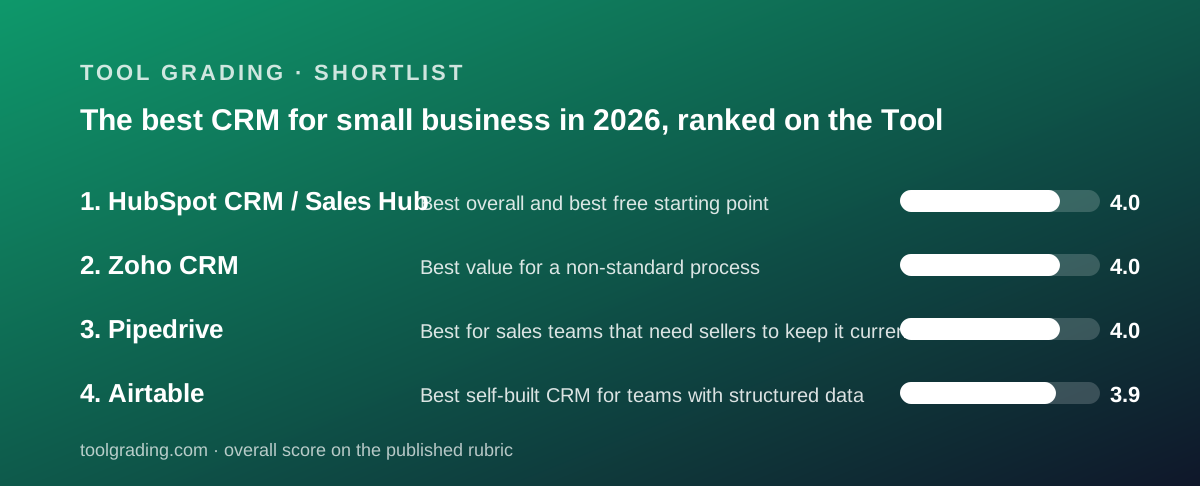
Three CRMs graded on this site, ranked by their total rubric score, plus Airtable as a fourth option for teams that would rather build a small CRM than buy one. HubSpot leads on the strength of its free tier and documentation, Zoho CRM is the strongest value for a non-standard process, and Pipedrive is the tool salespeople keep current. Figures come from the vendors' pricing pages as read on October 7, 2026 or are omitted where a review could not read them.
Our picks
- Best overall and best free starting point: HubSpot CRM / Sales Hub
- Best value for a non-standard process: Zoho CRM
- Best for sales teams that need sellers to keep it current: Pipedrive
- Best self-built CRM for teams with structured data: Airtable
This is a ranking from documentation and verified user reports, against the rubric described on the method page: ease of deployment for a small team, feature depth against real need, value at a ten-person team, and documented support. No first-hand testing was run for any product here and none is claimed. Three of the four entries are sold as CRMs; the fourth, Airtable, is a relational database with a spreadsheet interface that a great many small teams use as a CRM, and it is included with that caveat stated plainly rather than left out. The order is by the sum of the four sub-scores: HubSpot CRM at 16.2, Zoho CRM at 16.0, Pipedrive at 15.9 and Airtable at 15.7. The spread is half a point, which is a statement about the category rather than a failure to discriminate: these are four good products that fit four different teams, and the sub-scores tell the story the totals do not. Three of the four reviews describe the same realistic ten-person team, six salespeople, two managers, one operations person and one reader, so the value sub-scores compare on headcount even where no price could be printed.
Two of the four reviews could not read a live pricing page, and that shapes what this guide can say. The Pipedrive pricing page returned an access error on every attempt on October 7, 2026, and the Airtable review did not verify current prices, so neither product has a figure printed here; their value sub-scores are structural judgements and are described that way in the reviews. HubSpot's figures come from two official pages read the same day, with the caveat that the vendor displays promotional rates beside list rates. Zoho CRM's figures come from the edition comparison page in US dollars; the pricing page served to the reviewer's region showed a different ladder and currency, which the review records as a real variance. The practical rule for a buyer is the same in all four cases: open the vendor's page on the day of purchase, from the country where the business is billed.
HubSpot CRM takes first place at 16.2: ease 4.3, features 4.4, support 4.2, value 3.3. The review's central finding is that HubSpot is a shared customer record with products sold on top of it. Contacts, companies, deals and tickets are one database, and marketing, sales and support all write to the same contact timeline. The free CRM is a genuine, non-expiring database rather than a trial, which is why the migration cost of starting there is zero and why the product dominates the small-business end of the category. Per the pricing pages read October 7, 2026, Sales Hub Starter is a $20 per seat per month list rate, Professional starts at $100 and Enterprise at $150 per seat per month. The step from Starter to Professional is the largest single price step in the category, and sequences, custom reporting and call transcription sit on the far side of it. The documentation, Academy and community are among the most complete in business software, and that carries the support sub-score. Email and calendar integration is a first-class documented feature rather than an add-on, which the review names as the reason salespeople actually log activity, and the same record layout serves every object, so learning the contact screen is learning the deal screen.
The value sub-score of 3.3 is HubSpot's weakness and it is specific. For a ten-person team of six salespeople, two managers and two readers, the review's arithmetic runs: all ten on free seats at zero cost within the published caps, eight working seats on Starter at the $20 list rate for $160 per month, or eight seats on Professional at the $100 starting rate for $800 per month, which is $9,600 per year before any onboarding fee. At the bottom of the ladder HubSpot is the best value in the category; at the rung where a growing sales team usually lands, it competes with dedicated sales platforms. Verified reports describe the price trajectory rather than the headline as the most common reason for leaving: a feature two tiers up, a second hub seat for the same person, contact-tier limits in Marketing Hub, and a renewal that does not carry the first-year promotion. Custom objects are an Enterprise feature per the product page.
Zoho CRM is second at 16.0: features 4.5, value 4.4, ease 3.6, support 3.5. The review found the product that treats configuration as the point: custom modules, layouts, field rules, workflow rules and blueprint process enforcement are documented at editions priced below rivals' entry tiers, and the edition comparison page publishes hard caps rather than hiding them. Per that page, checked October 7, 2026, the Free edition covers 3 users with workflow rules, Starter is $14, Standard $23, Professional $40 and Enterprise $52 per user per month billed annually. Ten users on Standard cost $2,760 per year, which the review calls the cheapest working CRM graded on this site for that headcount; ten on Professional cost $4,800 per year and lift the custom-field cap from 10 per module to 155. Blueprint, which enforces a state sequence with required fields at each transition, has no equivalent at a comparable price among the other three products. The free edition includes 5,000 records, 1 GB of storage and 5,000 API credits per day, and the paid editions publish API credits of 100,000 per day on Starter and Standard rising to 500,000 on Professional, which matters to a team that will connect the CRM to its billing or marketing tools.
What holds Zoho CRM in second place is the two lower sub-scores, and both are costs the buyer should know in advance. Ease at 3.6 is a score for a product that is easy to start and hard to configure well: the interface exposes every module by default, the administrative concepts are separate screens, and verified reports are consistent that teams which skipped the configuration fortnight describe the tool as cluttered while teams which did it describe the same interface as fine. Support at 3.5 is the lowest of any product in this guide. The documentation home page emphasises self-service and does not map channels to editions; the vendor's published practice has been email and community support as standard with phone and chat depending on region and separately sold support plans. Verified reports describe slow or inconsistent escalation with more regional variation than most vendors. A business needing a written response commitment should get one before buying.
Pipedrive is third at 15.9: ease 4.5, features 3.9, value 3.8, support 3.7. The review describes the most disciplined product in the category about its own scope: a deal moves through a pipeline, every open deal should have a next activity scheduled, and the seller's home screen is the list of activities due today rather than a dashboard. Verified reports name adoption by salespeople as the consistent strength, which is the single hardest problem in CRM rollouts, and the pipeline view as the best-executed surface in the category. The boundary is just as clear: no marketing automation worth the name in the core product, no support ticketing, and reporting that is capped per plan and oriented to pipeline metrics. The four plans are Lite, Growth, Premium and Ultimate, each priced per seat, with a seat charged whether or not a user is assigned to it. No price is printed because the pricing page could not be read. The API and marketplace are well documented, with official client libraries and an OpenAPI specification, and the mobile application is treated as a first-class surface in the documentation, which matters for field sales.
The plan structure is the thing a Pipedrive buyer most needs to understand, and the review documents it from the knowledge base. Email sync, templates, open tracking and automations are absent from Lite, so the bottom tier is a pipeline board with manual data entry rather than a working sales tool, and the review's ease score assumes Growth. Live chat support begins at Growth and phone support at Premium; Lite customers get a chatbot. Reports are capped at 50 on Growth and 250 per user on Premium, and leads plus deals at 5,000 per user on Growth. Premium includes the Projects, Smart Docs and LeadBooster add-ons that are sold separately below it, so a team that would buy two of those should price Premium instead. For a ten-person sales team, Growth is the realistic floor and, for a team without process variation, probably the ceiling for a year or two.
Airtable is fourth at 15.7 and belongs on this list with its label attached: it is not a CRM, it is the tool many small teams build one from. Its sub-scores are ease 4.2, features 4.4, support 3.8 and value 3.3. The review found a relational database with a spreadsheet's learning curve, where the linked-record field is the feature everything hangs off: one customer row referenced by many deal rows, updated in one place, with grid, kanban and calendar views that are saved queries over the same records rather than copies. Forms write straight into a table and automations handle the recurring work, so a team with a sales process that no vendor's pipeline fits can model exactly what it does. No price is printed because the review did not verify the live pricing page; the documented structure is a free tier with record and attachment caps and per-seat tiers above it that bill for read-only colleagues on the tiers most teams need. The ease sub-score of 4.2 reflects an onboarding path a spreadsheet user can follow inside an hour, with a conceptual step at linked records, lookups and rollups that a meaningful share of teams never cross; the template gallery is the most effective teaching tool, because it shows a correctly normalised base rather than describing one.
The self-built route has costs that the three packaged products do not, and the Airtable review names them. Nothing in a base enforces a sales process; the pipeline stages, the activity reminders and the reporting that Pipedrive ships as defaults have to be designed, and a base that grows without someone owning its schema degrades into wide, duplicated tables that are harder to fix than the spreadsheet it replaced. There is no email sync in the sense a CRM means, no sequences, no call logging, and the reporting is adequate for operational questions rather than for a sales manager's forecast. Verified reports describe cost arriving later rather than sooner, as adoption spreads to colleagues who only read. The right buyer is an operations or client-services team whose customer data has real structure, whose process is unusual, and who has nobody to build an internal app; a conventional sales team should buy a conventional CRM. Reporting is deliberately shallow, with summaries, groupings and charts that are adequate for operational questions and not a replacement for a business intelligence tool, and the documentation does not claim otherwise.
The practical order is by the shape of the team. A business that wants one contact record shared by marketing, sales and support, and that can start on free tools and grow into paid ones, should start with HubSpot and budget for the tier it will actually need rather than the tier it starts on. A business with a process that does not fit a standard pipeline, one person willing to configure modules and blueprints, and a modest budget should start with Zoho CRM Standard or Professional. A pure sales team of three to thirty whose problem is getting sellers to maintain the system should start with Pipedrive on Growth and read the plan comparison before choosing. A team whose customer data has shape but whose process is nothing like a sales funnel should consider Airtable, with a named schema owner. In every case the figures here were true on October 7, 2026 and should be checked against the live page before signing.
Best overall and best free starting point: HubSpot CRM / Sales Hub
Total 16.2: ease 4.3, features 4.4, value 3.3, support 4.2. A shared record of contacts, companies, deals and tickets with Sales, Marketing and Service hubs sold on top, so every team sees one customer timeline. The free CRM is a real, non-expiring database. Per the pricing pages read October 7, 2026, Sales Hub Starter lists at $20 per seat per month, Professional from $100 and Enterprise from $150, and the Starter-to-Professional step is the largest in the category: eight Professional seats are $9,600 per year before onboarding fees. Documentation and the Academy are among the best in business software. Verified reports name price trajectory, not the headline rate, as the reason teams leave.
Visit HubSpot CRM / Sales Hub
We have no affiliate relationship with this vendor. Link goes to the official site.
Best value for a non-standard process: Zoho CRM
Total 16.0: ease 3.6, features 4.5, value 4.4, support 3.5. Custom modules, field rules, workflow rules and blueprint process enforcement at editions priced below rivals' entry tiers, with hard caps published on the edition comparison page. Per that page, checked October 7, 2026: Free for 3 users, Starter $14, Standard $23, Professional $40 and Enterprise $52 per user per month billed annually, so ten users on Standard cost $2,760 per year and on Professional $4,800. Custom fields are capped at 10 per module below Professional. The interface is dense until configured, which takes about a fortnight of one capable person, and support channels vary by region and paid plan.
Visit Zoho CRM
We have no affiliate relationship with this vendor. Link goes to the official site.
Best for sales teams that need sellers to keep it current: Pipedrive
Total 15.9: ease 4.5, features 3.9, value 3.8, support 3.7. One object and one rule: a deal in a pipeline, with a next activity always scheduled, and a seller's home screen built from that. Verified reports name adoption by salespeople as the consistent strength. Four per-seat plans, Lite, Growth, Premium and Ultimate; email sync and automations begin at Growth, live chat support at Growth and phone support at Premium, reports are capped at 50 on Growth, and Premium bundles the Projects, Smart Docs and LeadBooster add-ons. No price is printed because the pricing page could not be read on October 7, 2026 and the review's value score is a structural judgement.
Visit Pipedrive
We have no affiliate relationship with this vendor. Link goes to the official site.
Best self-built CRM for teams with structured data: Airtable
Total 15.7: ease 4.2, features 4.4, value 3.3, support 3.8. Not a CRM but a relational database with a spreadsheet interface that many small teams build one from: linked records keep one customer row referenced by many deal rows, views are saved queries over the same data, forms write straight into tables, and automations and interfaces put a front end on it. There is no email sync, no sequences and no enforced process, and a base without a schema owner degrades into the spreadsheet it replaced. No price is printed because the review did not verify the live pricing page; the structure is a free tier with record caps and per-seat tiers that bill read-only colleagues.
Visit Airtable
We have no affiliate relationship with this vendor. Link goes to the official site.
How we chose
Three CRMs and one database tool with full reviews on this site were ranked by the sum of their four rubric sub-scores, ease, features, value and support, as defined on the method page. Sub-scores were built from vendor documentation, pricing pages read on October 7, 2026 where they could be read, and patterns in verified user reports on public review platforms. No first-hand testing was run and none is claimed. The Pipedrive pricing page returned an access error and the Airtable review did not verify current prices, so no figures are printed for either. Airtable is included as a self-built CRM option and labelled as such; it is ranked by its score like the others.
Frequently asked
Why is Airtable on a list of CRMs?
Because a great many small teams use it as one, and leaving it out would hide a real option. It is labelled as a self-built CRM throughout: a relational database with a spreadsheet interface, not a sales product with pipelines, email sync and sequences. It is ranked by its rubric total like the other three and placed last on that basis.
Why are there no prices for Pipedrive or Airtable?
The Pipedrive pricing page returned an access error on every attempt on October 7, 2026, and the Airtable review did not verify current figures against the live page. This site does not print a price it has not checked, so both reviews describe pricing structure only and their value sub-scores are structural judgements.
Which is cheapest for a ten-person team?
Among the products with verified figures, HubSpot's free CRM at zero cost within the published caps is the floor, and Zoho CRM Standard at $23 per user per month billed annually, or $2,760 per year for ten, is the cheapest fully working paid CRM graded on this site. HubSpot Sales Hub Professional for eight seats at the stated $100 starting rate is $9,600 per year, which is the figure that moves HubSpot to the expensive end once a team needs sequences and custom reporting.
Did this site test any of these products?
No. Every grade is a documentation review built from vendor documentation, pricing pages and patterns in verified user reports, against the published rubric. No first-hand testing was run and none is claimed. The method page explains how each sub-score is built.