 Tool
ToolGusto vs Deel: domestic payroll against global employment, and why the price gap is the product
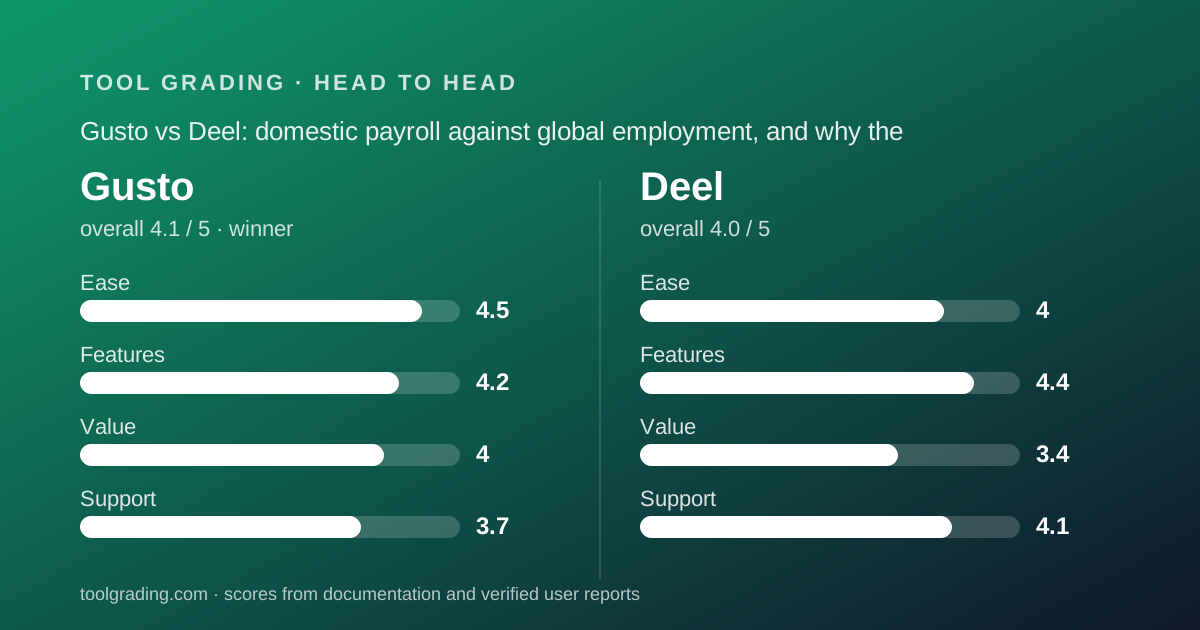
Gusto grades 4.1 overall and Deel 4.0, and the two products rarely compete for the same business. Gusto is full-service US payroll at $49 per month plus $6 per person on its Simple tier; Deel is a set of legal employment relationships sold through one interface, at $49 per contractor, $125 per US PEO employee and $599 per Employer of Record employee per month. Gusto wins this comparison for a US-only team of ten by a wide margin on price. Deel wins the moment one of the ten is employed in a country where the business has no entity.
 4.1Gusto
 4.0Deel
The short answer
This is a documentation comparison built from the two underlying grades on this site, Gusto and Deel, and from the vendors' pricing pages as of October 2026; no first-hand testing was run.
Gusto scores 4.5 on ease, 4.2 on features, 4.0 on value and 3.7 on support, a sum of 16.4 and an overall of 4.1. Deel scores 4.0, 4.4, 3.4 and 4.1, a sum of 15.9 and an overall of 4.0. Gusto wins on ease and value, Deel wins on features and support, and Gusto takes the comparison because the rubric calculates value for a team of ten and, for a ten-person US team, the difference in cost is not a matter of degree.
The argument is about what each product sells. Gusto sells payroll processing: it calculates pay, withholds taxes, files federal and state returns, makes the tax payments and issues W-2s and 1099s, with a benefits brokerage and a light HR layer attached. Deel sells legal relationships: a managed contractor, a contractor employed by Deel's entity on your behalf, an employee legally employed by Deel's entity in another country, or a US employee under Deel's co-employment PEO. The software is one interface over all of them; what differs is who is legally the employer and what that costs.
Both reviews say the same thing about the other product, and this page agrees with both. The Gusto review says Deel is the wrong tool for a US-only team and the right one for an international team. The Deel review says a US-only business is paying for cross-border infrastructure it does not use, and names Gusto as the alternative, adding that it is not a close call. The useful work of this page is therefore not to pick a winner in the abstract but to show where the line falls, and what each side of it costs for ten people.
How the two products are structured
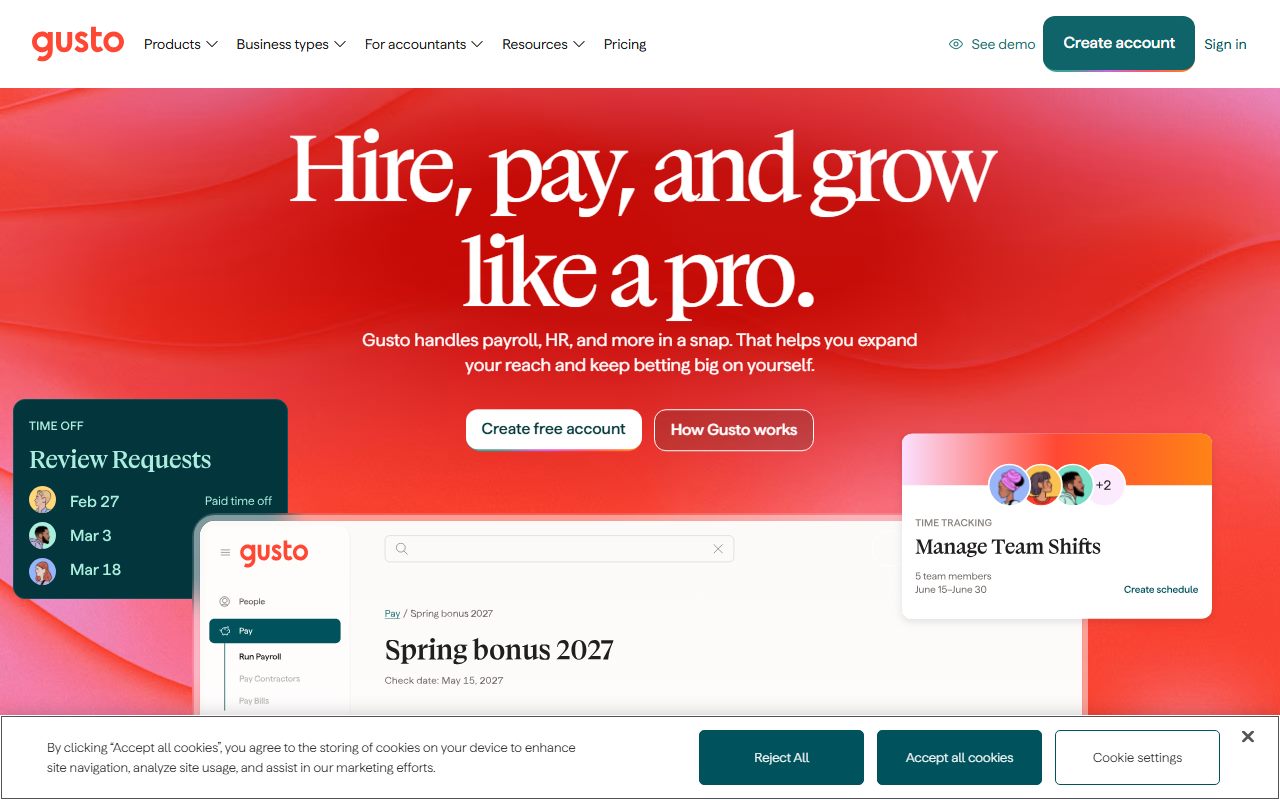
Gusto's data model is a company, its work locations and tax registrations, and its people, each a W-2 employee or a domestic contractor with a pay rate, a schedule, deductions and benefits elections. Payroll runs are events against that model; time tracking, PTO, expenses, benefits and documents feed into or read from it. The employee has their own login and app for onboarding paperwork, pay stubs, tax forms and benefits enrolment, which the Gusto review notes is the part of the product most often praised in verified reports. The HR layer is deliberately light. The structural fact that decides the tier is geography: Simple runs payroll in one state, and multi-state payroll is on Plus and above.
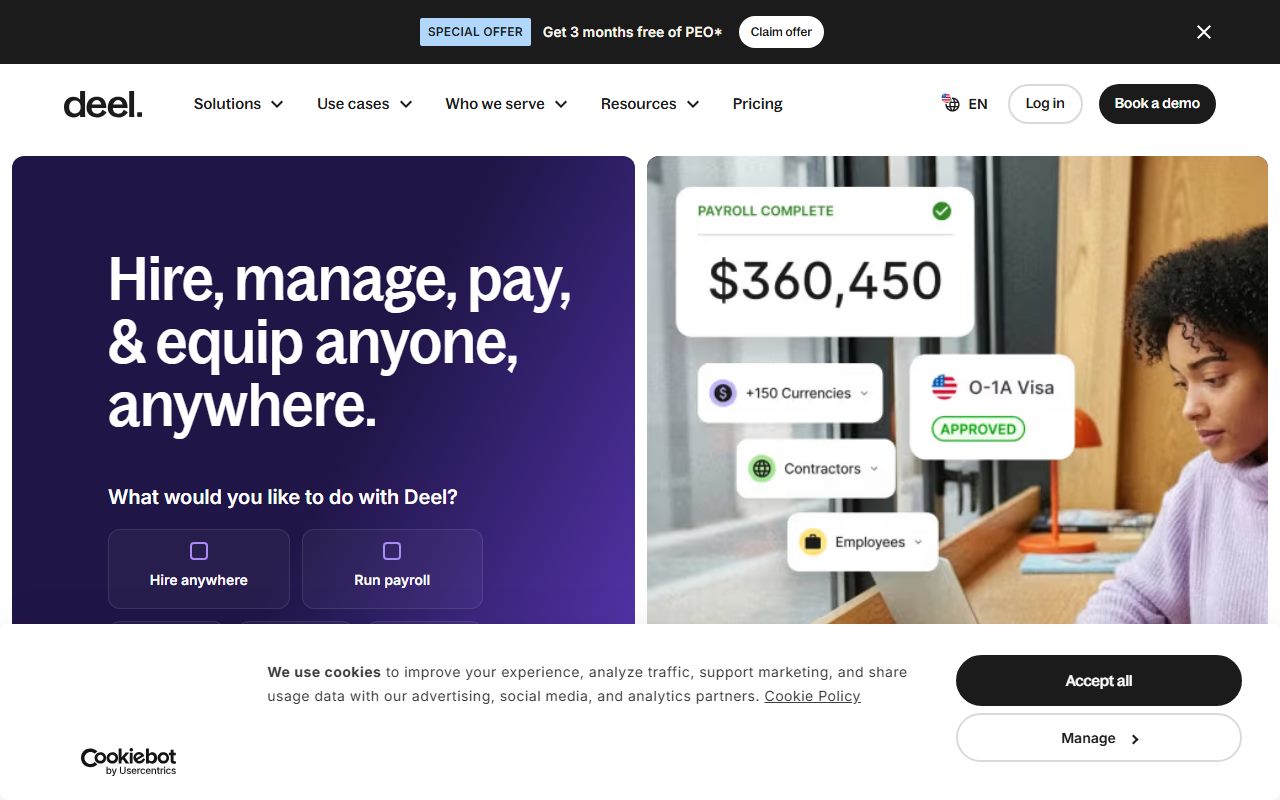
Deel's data model is a company, its workers, and for each worker a relationship type, a country, a contract, a pay schedule and a currency. The relationship types, from the pricing page: contractor management, where the worker is your contractor and Deel provides the localised contract, classification guidance, invoicing and multi-currency payment; Contractor of Record, where Deel's entity contracts with the worker and the misclassification risk moves to Deel; Employer of Record, where the worker is a full employee of Deel's local entity; and US PEO, co-employment across all 50 states. Global payroll for owned entities is quoted rather than listed. The vendor cites EOR entities in 130-plus countries.
The overlap between the two is narrow. Gusto offers global contractor payments as an add-on at $5 per payment with variable FX, for contractors in 120-plus countries, and does not support foreign employees at all. Deel offers US PEO at $125 per employee per month, and the Deel review says domestic US payroll as a standalone is not the product's centre. A US business with a handful of overseas contractors can stay on Gusto; a business with one foreign employee cannot.
Pricing for a 10-person team (as of October 2026)
Both pricing pages were read on October 7, 2026, and both reviews describe them as unusually explicit. Gusto's page states base fee plus per-person fee per tier with every add-on priced; Deel's lists per-worker rates per relationship with no long-term contract. Neither displayed a promotional rate on the tiers and neither lists a free tier.
Gusto for ten people. Simple at $49 per month plus $6 per person is $109 per month for ten W-2 employees in one state, with unlimited payroll runs, federal and state filings and payments, direct deposit, basic PTO and the employee app. Plus at $80 plus $12 per person is $200 per month, and is required for multi-state payroll, built-in time tracking and next-day pay; the step is $91 per month, or 83%, driven by the per-person fee doubling. Premium at $180 plus $22 per person is $400 per month. Simple with Priority Support and Time and Attendance Plus for ten people is $229 per month, more than Plus with both included, so a Simple-tier business adding two add-ons should price Plus instead.
Deel for ten people depends on the composition of the ten. Ten managed international contractors are $490 per month in platform fees plus currency conversion. Ten EOR employees in countries where the business has no entity are $5,990 per month in Deel fees before local employer costs, which are passed through on top. Ten US employees on PEO are $1,250 per month plus benefits premiums. The Deel review's mixed example, three EOR employees, two US PEO employees and five contractors, is $2,292 per month in Deel fees. Global payroll for owned entities is not priced on the page.
The comparison both reviews make: ten US employees on Gusto Simple at $109 per month against Deel US PEO at $1,250 per month, which the Deel review says Deel loses by a wide margin. The comparison neither can make: Gusto has no price for a foreign employee, because it has no product for one.
- Gusto Simple: $49/mo plus $6 per person; $109/mo for ten employees in one state (pricing page, October 7, 2026)
- Gusto Plus: $80/mo plus $12 per person; $200/mo for ten; multi-state payroll, time tracking, next-day pay
- Gusto Premium: $180/mo plus $22 per person; $400/mo for ten; named support contact, HR guidance, compliance tooling
- Gusto add-ons: Priority Support $30/mo plus $3 per person; Time and Attendance Plus $6 per person; global contractor payments $5 per payment
- Deel contractors: $49 per contractor per month; Contractor of Record $325; $490/mo for ten managed contractors (pricing page, October 7, 2026)
- Deel EOR: $599 per employee per month plus local employer costs; $5,990/mo in Deel fees for ten
- Deel US PEO: $125 per employee per month; $1,250/mo for ten; global payroll for owned entities quoted, not listed
Ease of use
Gusto leads, 4.5 against 4.0, and both scores describe products that make a complicated process short while the complication remains real underneath.
Gusto's score reflects a workflow that is as short as payroll can be made. The employer loop, per the documentation: add a person, who completes their own onboarding through their login; set pay and schedule; approve payroll on the scheduled day, or let AutoPilot approve it for salaried staff. Taxes, filings and payments happen without further action. For a salaried team in one state, the Gusto review puts the monthly effort after setup at close to zero. Setup is where the work sits, because historical payroll data, tax registrations and benefits elections must be entered correctly before the first run; verified reports describe migration as manageable for a small team and tedious mid-year. Two things lower the score: multi-state employment introduces state tax registration, sold as an add-on and described by users as the first place the simple product becomes complicated, and time tracking on Simple is a paid module to configure.
Deel's score reflects a product that makes employing someone in another country feel like a short form. The contractor workflow is a localised contract template, the contractor's signature and document upload, invoices generated on schedule, approval, and payment in the contractor's currency. For an EOR employee, the vendor states onboarding can complete in as little as one day. Where ease drops is not the software: the legal choice between contractor, Contractor of Record and EOR has to be made per worker and is a legal decision, and country-specific rules on notice, probation and termination still have to be understood.
The 0.5 difference is the difference between a product whose complexity is set up once and a product whose complexity recurs with every new country.
Feature depth
Deel leads, 4.4 against 4.2, and the Deel review is explicit that its score is carried by coverage rather than by any single feature.
Deel's inventory: EOR entities in 130-plus countries, compliance coverage in 150-plus, contractor payments in 120-plus currencies, and 200-plus legal experts maintaining country rules, all vendor-cited and corroborated in pattern by verified reports. The contractor product is the most complete reviewed on this site: localised templates, classification assessment, document collection, automated invoicing, approval flows, multi-currency payouts and tax-form guidance. The EOR product adds local statutory and optional benefits, managed payroll and filings, and access to the legal team. US PEO adds domestic co-employment with benefits. The HR layer is described by verified users as adequate for a small company. What is thinner: domestic US payroll as a standalone is not the centre, performance management is not the reason to buy, and the EOR experience in any given country depends on local law and partners.
Gusto's 4.2 is a complete payroll core, an integrated benefits layer and a deliberately light HR layer. Unlimited runs, multiple pay rates and schedules, direct deposit, automatic federal and state filings and payments, year-end forms, domestic contractor payments and an employer app are on every tier, with contractor invoice upload and workforce cost reports on Plus and custom admin roles and project costing on Premium. Benefits are integrated rather than referred out: health, dental and vision through licensed brokers with premiums as the only stated cost, 401(k) through integrations, HSA and FSA at per-participant fees, and pay-as-you-go workers' compensation, with the vendor's disclaimer that plan availability varies by state. What is outside scope: international employees, and anything resembling talent management.
The 0.2 difference is the measure of a product that does one country completely against a product that does 130 countries through partners. For a US-only business the Deel features that earn the extra 0.2 are features it will never use.
Support and documentation
Deel leads, 4.1 against 3.7, and the gap is stated commitments against a verified pattern of complaint, with one documentation gap on the Deel side that the review names.
Deel's product pages, read on October 7, 2026, state 24/7 support across continents in the customer's language and time zone, SLA-backed onboarding and compliance on managed payroll, a dedicated payroll manager on the managed tier, access to 200-plus in-house legal experts, and SOC 2 Type II, ISO 27001 and GDPR compliance. The vendor displays a 4.8 out of 5 rating across 15,000-plus G2 reviews, noted as a claim. The help centre did not load for the Deel review and is not graded; the review advises buyers to open it and check the country guides for their target countries. Verified reports describe support as responsive on platform and payment questions and more variable on country-specific employment questions, with complaints concentrated on terminations and final payments in some countries.
Gusto's help centre, read the same day, is organised by audience and by topic, and the review calls the depth of the taxes and compliance section appropriate for a product whose main risk is misconfigured tax registration. Assisted support is tiered: expert support on all tiers, a named contact on Premium, and Priority Support purchasable on Simple and Plus at $30 per month plus $3 per person. No support hours or response-time commitments are published. Verified reports describe responsive support for routine questions and slow or inconsistent support during peak periods, quarter end, year end and tax notices, and the review treats the existence of a paid priority tier as evidence that standard response is not always fast.
Neither entry estimates response time. The 0.4 reflects Deel's stated commitments and certifications against Gusto's documented pattern of peak-period slowness, with the caveat that Deel's help centre could not be read and Gusto's could.
What verified users report
Both reviews weigh public reports as pattern rather than measurement.
For Gusto, the dominant positive is simplicity: payroll that runs itself, taxes filed without the owner thinking about them, and an interface a non-specialist can operate. Second is the employee experience: self-onboarding, the app, pay stubs and W-2s, and benefits enrolment without HR help. The dominant complaint is support, specifically wait times and the handling of tax notices and corrections, with year-end issues named most often. Second is price growth: the per-person fee at Plus for a growing team and the number of add-ons a business ends up buying.
For Deel, the dominant positive is that it works: contracts are signed, people are onboarded in days rather than months, and they are paid in their own currency on time. Second is the worker-side experience and breadth of country coverage. The dominant complaint is cost, specifically the EOR fee per employee relative to local salaries in lower-cost countries, which the review calls a pricing-model objection and the most cited reason for considering alternatives. Second is variability by country: benefits that differ from expectations, terminations that take longer or cost more than anticipated, and local partners whose responsiveness varies.
The two patterns do not overlap much, which is itself the finding. Gusto's users complain about the vendor's support and about add-ons; Deel's users complain about a per-head fee that is the price of the legal structure they bought. A ten-person business should recognise which set of complaints describes a problem it has.
Choose Gusto if / choose Deel if
Choose Gusto if the business is a US employer of roughly five to fifty people with W-2 employees, perhaps some domestic contractors, no dedicated HR or payroll person, and an owner who wants payroll to be a monthly approval. Choose Simple at $49 per month plus $6 per person, per the pricing page checked October 7, 2026, if everyone is in one state and time tracking is not needed; accept Plus at $80 plus $12 per person as the real price if the team spans two states or needs built-in time tracking. Choose it if the accounting is on QuickBooks Online, Xero, which resells Gusto as its US payroll, or FreshBooks. Choose it if a handful of overseas contractors is the full extent of the international workforce, since the global contractor add-on handles that at $5 per payment. Do not choose it if any employee is outside the United States, because the product does not support foreign employees, and do not expect fast support at year end without budgeting for the priority add-on.
Choose Deel if the business employs or contracts people in countries where it has no entity, and the alternative is opening a foreign subsidiary or misclassifying an employee as a contractor. Choose managed contractors at $49 per month where the role is genuinely a contractor role, and EOR at $599 per month plus local employer costs where it is not; the choice between them is a legal question about the worker's role, not a budget preference. Request the all-in cost of an EOR employee in each target country, and request the global payroll quote if the business owns entities. Do not choose it for a US-only workforce, because the Deel review itself says Gusto is the right tool there by a wide margin, and model the entity if five or more people will be employed in one country.
The honest middle case is a ten-person US business with one engineer in another country. That business can run Gusto for the nine and, if the engineer is genuinely a contractor, pay them through Gusto's add-on or Deel's contractor product. If the engineer must be an employee, it needs Deel EOR for that one person, and the two products run side by side.
Bottom line
Gusto wins this comparison, 4.1 against 4.0 overall and 16.4 against 15.9 on the sum of sub-scores. It wins ease (4.5 against 4.0) and value (4.0 against 3.4), and loses features (4.2 against 4.4) and support (3.7 against 4.1). The verdict holds for the team the rubric prices, ten people, because for a US team of ten the two products are separated by an order of magnitude rather than a margin.
The figures, per both pricing pages checked October 7, 2026: ten US employees in one state on Gusto Simple are $109 per month; the same ten on Deel US PEO are $1,250 per month plus benefits premiums; ten employees abroad on Deel EOR are $5,990 per month in Deel fees before local employer costs. The first comparison is the one most ten-person businesses are making, and Gusto wins it by a wide margin, as the Deel review itself states. The third is not against Gusto at all, because Gusto has no product for a foreign employee; it is against the cost of opening entities in those countries, and for one or two people per country the Deel review says EOR is almost always cheaper and faster.
The two reviews agree on the line, and this page draws it the same way. A US team: Gusto, and budget for Plus if the team crosses a state line. People in three countries: Deel, and treat the per-head fee as the price of not opening three entities. Five people in one country: model the entity before paying EOR for all five.
Open both live pricing pages before deciding, and ask Deel for the all-in EOR cost per country, since the listed fee is not the whole bill. This is a documentation comparison, and no first-hand testing was run or is claimed.
Visit Gusto
We have no affiliate relationship with this vendor. Link goes to the official site.
Visit Deel
We have no affiliate relationship with this vendor. Link goes to the official site.