 Tool
Tool
Zendesk
The reference ticketing platform: deepest workflow and data model in the category, priced and packaged for teams that will grow into it.
Scored on the published rubric, from documentation, pricing and verified user reports.
Best for: Support operations of ten to several hundred agents that need custom workflow, multiple brands or help centres, and a data model other systems can build on.
Verdict
Zendesk is the product the rest of the ticketing category is measured against, and its documentation shows why: the ticket, user, organisation and group model is clean, triggers and automations are expressive, views and macros are the agent surface everyone else copies, and the Suite plan documentation describes a ladder that reaches multiple help centres, skills routing, SLA management, custom reporting and a sandbox. The cost is that the ladder is long and the useful rungs are high: SLA management and custom reports arrive at Professional per the plan documentation, light agents are documented on Growth, and the pricing page could not be read for this entry, so no figures are printed and the value score is a structural judgement. For a ten-person team that needs what Team or Growth contains, [Freshdesk](/review/freshdesk/) delivers a close equivalent at a verified lower rate. For an operation that will need the Professional and Enterprise capabilities, Zendesk is the safer long-term platform. This grade comes from vendor documentation, pricing structure and verified user reports, against the published rubric; it is a documentation review, no first-hand testing was run and none is claimed.
Visit Zendesk
We have no affiliate relationship with this vendor. Link goes to the official site.
Where it is strong
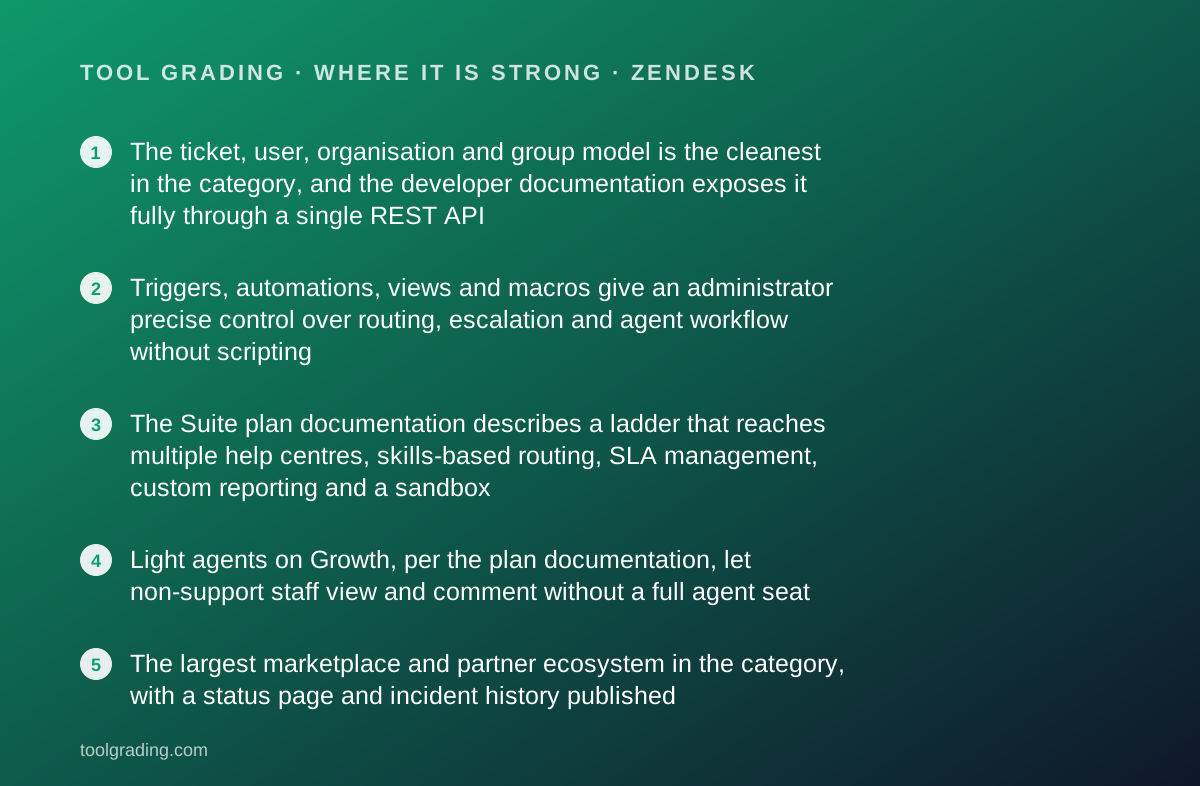
- The ticket, user, organisation and group model is the cleanest in the category, and the developer documentation exposes it fully through a single REST API
- Triggers, automations, views and macros give an administrator precise control over routing, escalation and agent workflow without scripting
- The Suite plan documentation describes a ladder that reaches multiple help centres, skills-based routing, SLA management, custom reporting and a sandbox
- Light agents on Growth, per the plan documentation, let non-support staff view and comment without a full agent seat
- The largest marketplace and partner ecosystem in the category, with a status page and incident history published
Where it falls short
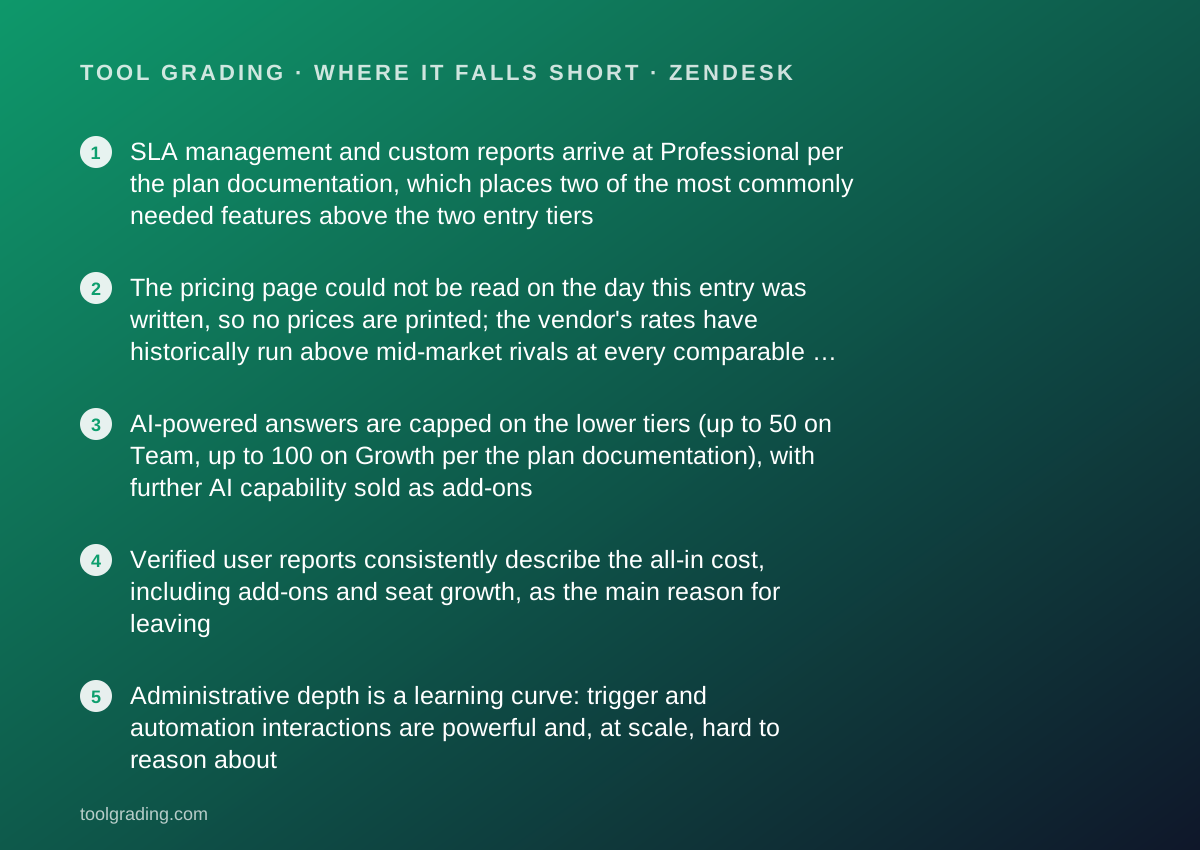
- SLA management and custom reports arrive at Professional per the plan documentation, which places two of the most commonly needed features above the two entry tiers
- The pricing page could not be read on the day this entry was written, so no prices are printed; the vendor's rates have historically run above mid-market rivals at every comparable rung
- AI-powered answers are capped on the lower tiers (up to 50 on Team, up to 100 on Growth per the plan documentation), with further AI capability sold as add-ons
- Verified user reports consistently describe the all-in cost, including add-ons and seat growth, as the main reason for leaving
- Administrative depth is a learning curve: trigger and automation interactions are powerful and, at scale, hard to reason about
What the product actually is
Zendesk is a ticketing platform with a data model that has become the category's default. The developer documentation, read on October 7, 2026, describes a single REST API over tickets, users, organisations and groups. A ticket is a conversation with a requester, a status, a priority, a type, tags, custom fields, an assignee and a group, and a timeline of public replies and private comments. A user is a person with a role (end user, agent, administrator, and the light agent role at some tiers). An organisation groups users and lets tickets inherit properties. A group is a team of agents that tickets can be routed to.
Three mechanisms act on that model. Triggers fire when a ticket is created or updated and can change fields, notify people or route. Automations fire on a timer, which is how escalation and reminders work. Views are saved queries that make up the agent's queue, and macros are canned actions an agent applies in one click. Everything a Zendesk administrator does is some combination of those four things, and every help desk graded on this site is some simplification of them.
Around the core sit the Suite components: a help centre for self-service (one on Team, multiple on Growth and above per the plan documentation), messaging and chat, voice, community forums, reporting through the analytics product, and AI agents for automated answers. The plan documentation describes these as bundled into the Suite tiers rather than sold separately, with add-ons for higher-volume AI and API use.
Who it is for, and who it is not
The operation this fits best is a support function that is, or expects to become, large enough to need the upper rungs: ten agents growing to a hundred, multiple brands or products each needing its own help centre, customer classes with different SLA commitments, skills-based routing across languages or specialties, and a data or engineering team that will build on the API. Verified user reports place software companies, marketplaces, consumer services and multi-brand retailers among the typical users, and the shared property is complexity that will grow.
Two kinds of team it fits less well. The first is the small team whose needs are contained in the Team or Growth tier: one help centre, email and chat, a single SLA. The plan documentation shows SLA management and custom reports at Professional, which means that team either does without or pays for a rung it mostly will not use. Freshdesk delivers a close equivalent at a verified lower rate, and that comparison is made honestly throughout this page. The second is a team wanting support on the same customer record as sales and marketing, which is the model of HubSpot CRM rather than a dedicated ticketing platform.
How the pricing is structured
The official pricing page could not be read on October 7, 2026; every attempt ended in a connection error. No prices are printed in this entry as a result, and that is a standing rule on this site rather than a hedge. What follows is the structure, taken from the vendor's own plan documentation read the same day.
The Suite is sold in five tiers: Team, Growth, Professional, Enterprise and Enterprise Plus. Each is priced per agent per month, with annual and monthly billing options; the plan documentation does not state rates. The vendor also sells a narrower Support-only product line, documented separately, for teams that want ticketing without the bundled messaging, voice and help centre components.
The plan documentation maps features to tiers. Team includes a single help centre and up to 50 AI-powered automated answers. Growth adds multiple help centres, up to 100 automated answers, skills-based routing, light agents and a self-service portal. Professional adds SLA management, custom reports, community forums and, for plans purchased after April 2023, the conversations platform. Enterprise adds custom permissions, customisable agent workspaces, branding controls, real-time shareable reports and a sandbox. Enterprise Plus adds an enhanced sandbox, enhanced disaster recovery and a high-volume API add-on.
- Team: single help centre, up to 50 AI-powered automated answers, pre-built reports
- Growth: multiple help centres, up to 100 automated answers, skills-based routing, light agents, self-service portal
- Professional: adds SLA management, custom reports, community forums
- Enterprise: adds custom permissions, agent workspaces, branding, real-time reports, sandbox
- Enterprise Plus: enhanced sandbox, enhanced disaster recovery, high-volume API add-on; all tiers per agent, prices not verified
Ease of use: what the score is built from
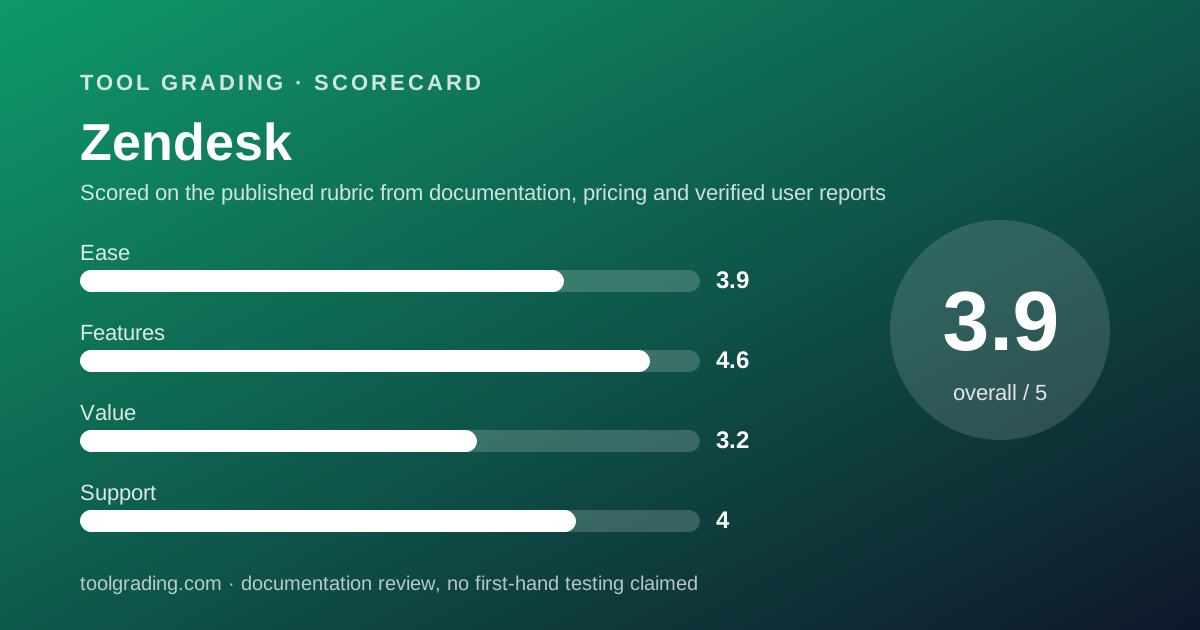
The ease sub-score of 3.9 separates the agent experience, which is excellent, from the administrator experience, which is demanding.
For the agent, the product defines the category. Views are the queue, the ticket screen is the conversation, macros are the one-click actions, and an agent who has used any help desk is productive immediately. The documentation for the agent workspace is thorough and the mobile application is a full client. Nothing on this page beats Zendesk at the agent surface.
For the administrator, the score is lower. The trigger and automation model is expressive, and expressiveness has a cost: triggers fire in order, interact, and at scale produce behaviour that is hard to predict. The help centre, read for this entry, is extensive on the subject, which is itself evidence that the subject needs explaining. Setting up a first help desk - connecting a support address, inviting agents, publishing a help centre - is documented and takes a day. Building a routing and escalation system that a growing team can rely on takes an owner and weeks, and the sandbox that makes experimenting safe is an Enterprise feature per the plan documentation.
The realistic picture for a ten-agent team: live in a day, properly configured in a month, and best with one person who owns the rules permanently. That is comparable to Freshdesk at the equivalent tier and heavier than either at the lowest tier.
Feature depth: what the score is built from
The feature score of 4.6 is the highest on this page and is earned on depth, ceiling and ecosystem.
What carries the score. The data model, which is clean enough that other systems are built on it. Triggers, automations, views and macros, which together cover routing, escalation, notification and agent productivity without scripting. Multiple help centres on Growth and above, which multi-brand companies need and most rivals gate higher or lack. Skills-based routing on Growth, where Freshdesk places it at Enterprise. SLA management with multiple policies at Professional. Custom reporting through the analytics product at Professional, and real-time shareable reports at Enterprise. Custom permissions and agent workspaces at Enterprise. A sandbox at Enterprise and an enhanced sandbox at Enterprise Plus. Messaging and voice bundled in the Suite. AI agents with automated answers included in capped quantities and extended by add-on.
The developer surface is the deepest in the category: a single REST API over all core objects, documented authentication, an apps framework, and the largest marketplace of pre-built integrations. For a company whose support data feeds other systems, that is the decisive capability.
Value at a realistic team size
Because no price could be verified, this section reasons from structure, and the value score of 3.2 is a structural judgement that will be revised when the pricing page can be read.
Take a ten-person support team: eight agents working the queue, one lead who needs reporting, one administrator. On Growth and above, the lead and possibly the administrator could be light agents per the plan documentation, which reduces paid seats to eight or nine; on Team they are full seats.
Growth is the realistic floor for most ten-person teams because of light agents, multiple help centres and skills routing. Professional is the rung where SLA management and custom reports live, and verified user reports consistently describe that step as the one that hurts: two features most support leads consider basic sit on the far side of it.
Compared against Freshdesk, whose rates were verified for that entry at $19, $55 and $89 per agent per month billed annually on Growth, Pro and Enterprise: Freshdesk delivers multiple SLA policies and custom dashboards at its $55 mid tier, and Zendesk's plan documentation places the equivalents at Professional. Zendesk's rates have historically run above Freshdesk's at each comparable rung, and no figure is printed here because none was read.
The value score of 3.2 reflects that at ten agents the product's advantages are mostly above the rung such a team buys, that light agents are the only structural lever in the buyer's favour, and that add-ons for AI and API volume extend the bill. At a hundred agents with complex routing, the calculation changes and the score would be higher.
Support and documentation
The support sub-score of 4.0 is carried by documentation and ecosystem and discounted for tiered direct channels.
Self-service is extensive. The help centre read on October 7, 2026 includes product documentation organised by component, a dedicated series of plan-type articles that map features to tiers more clearly than most vendors manage, and a developer documentation site with API references, guides on ticket creation, custom forms, routing and reporting, and app development. The plan-type article used for this entry is a model of how a vendor should publish tier contents.
Direct channels are tiered, as they are across the category. The plan documentation references email, voice and chat support without mapping them per tier in the sections read, and the vendor has historically sold premium support plans with named contacts and response commitments separately from the Suite tiers. A buyer should confirm in writing what the intended tier includes and what a response commitment costs rather than assume it is bundled. This page will not estimate response times.
The discount in the score comes from verified user reports, which describe direct support as competent for product questions and slow for account, billing and renewal issues, with the pattern that larger accounts get better service. For a support software vendor that is a familiar irony, and it is reported often enough to count.
What verified users report
Across public review platforms and forums the reports about Zendesk are consistent in a way that reflects its market position.
The dominant positive is reliability and depth: users describe a platform that does not fall over, scales from ten agents to hundreds without migration, and can be made to do almost anything with triggers, automations and the API. The second positive is the agent experience, which users moving to other tools cite as the thing they miss. The third is the ecosystem, with integrations available for almost every adjacent system.
The dominant complaint is cost, and it is specific: not the headline per-agent rate but the trajectory - the step to Professional for SLA management and custom reports, the AI add-ons, the premium support plans, and renewals negotiated upward. This is the most frequently cited reason for leaving and it is a packaging objection more than a product objection.
The second complaint is administrative complexity, with reports of trigger systems that have grown beyond anyone's understanding and a sandbox that is gated at Enterprise.
These reports are weighed as evidence of pattern, not as measurements, and they are not converted into a number. They are why the value score sits more than a point below the feature score.
Alternatives on this site
Three alternatives graded here answer the common objections to Zendesk.
Freshdesk is the answer when the objection is price at the mid tier. Its rates were verified for that entry, it places multiple SLA policies and custom dashboards at its $55 Pro rung, and verified reports from migrated teams describe the agent experience as comparable. It is shallower at the top: skills routing and audit logs are Enterprise features there, the data model is less extensible, and a hundred-agent operation would feel the ceiling.
HubSpot CRM is the answer when the objection is that support should share a record with sales and marketing. Its ticketing is a competent help desk inside a customer platform rather than a dedicated one, and the comparison should be made on ticket workflow depth, where Zendesk is clearly ahead, against the single-timeline advantage, where HubSpot is.
Bottom line
Zendesk earns the highest feature score on this page and the lowest value score, and the gap is the whole review. It is the deepest, best-documented and most extensible ticketing platform graded here, and its ladder is built so that the capabilities most teams consider basic are reached at the third rung.
Buy it if your support operation is complex now or will be - multiple brands, customer classes with distinct SLAs, skills across languages or specialties, an engineering team that will build on the API - and if you are buying for the next five years rather than the next twelve months. Plan for an administrator who owns the rules, and plan for Professional.
Do not buy it if your needs fit the Team or Growth tier and will stay there, because a verified cheaper equivalent exists; if nobody will own the trigger and automation model; or if you need a response commitment from the vendor and have not priced the support plan that provides one.
Prices were not verified for this entry and none are printed; that is the largest gap on this page and it will be closed when the pricing page can be read. Open the live pricing page before you sign anything.
Visit Zendesk
We have no affiliate relationship with this vendor. Link goes to the official site.