 Tool
ToolFreshdesk vs Zendesk: the mid-market help desk against the category benchmark
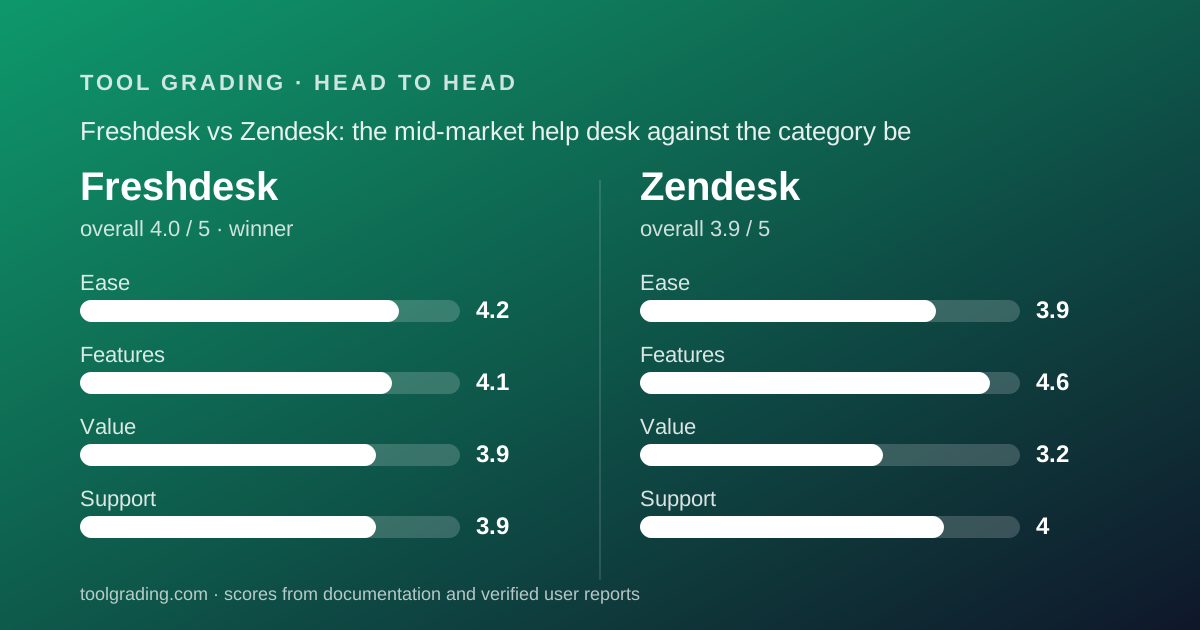
Freshdesk grades 4.0 overall and Zendesk 3.9, and the split is clean: Zendesk has the deepest feature set and the cleanest data model in the ticketing category, Freshdesk delivers the features a ten-agent team actually buys at a verified lower rate. Zendesk's pricing page could not be read on October 7, 2026, so no Zendesk prices are printed here. Freshdesk wins for a support team of two to fifty agents; Zendesk is the safer platform for an operation that will need Professional and Enterprise capabilities.
 4.0Freshdesk
 3.9Zendesk
The short answer
This is a documentation comparison built from the two underlying grades on this site, Freshdesk and Zendesk, and from the vendors' pricing pages as of October 2026; no first-hand testing was run. One caveat governs the pricing half of this page: Zendesk's official pricing page could not be read on October 7, 2026, and this site does not print a figure it has not checked. Zendesk's value score is therefore a structural judgement that will be revised when the page can be read.
Freshdesk scores 4.2 on ease, 4.1 on features, 3.9 on value and 3.9 on support, a sum of 16.1 and an overall of 4.0. Zendesk scores 3.9, 4.6, 3.2 and 4.0, a sum of 15.7 and an overall of 3.9. Freshdesk wins on ease and value, Zendesk wins on features and, narrowly, on support, and Freshdesk takes the comparison because the two axes it wins are the ones a ten-agent team pays for in the first year.
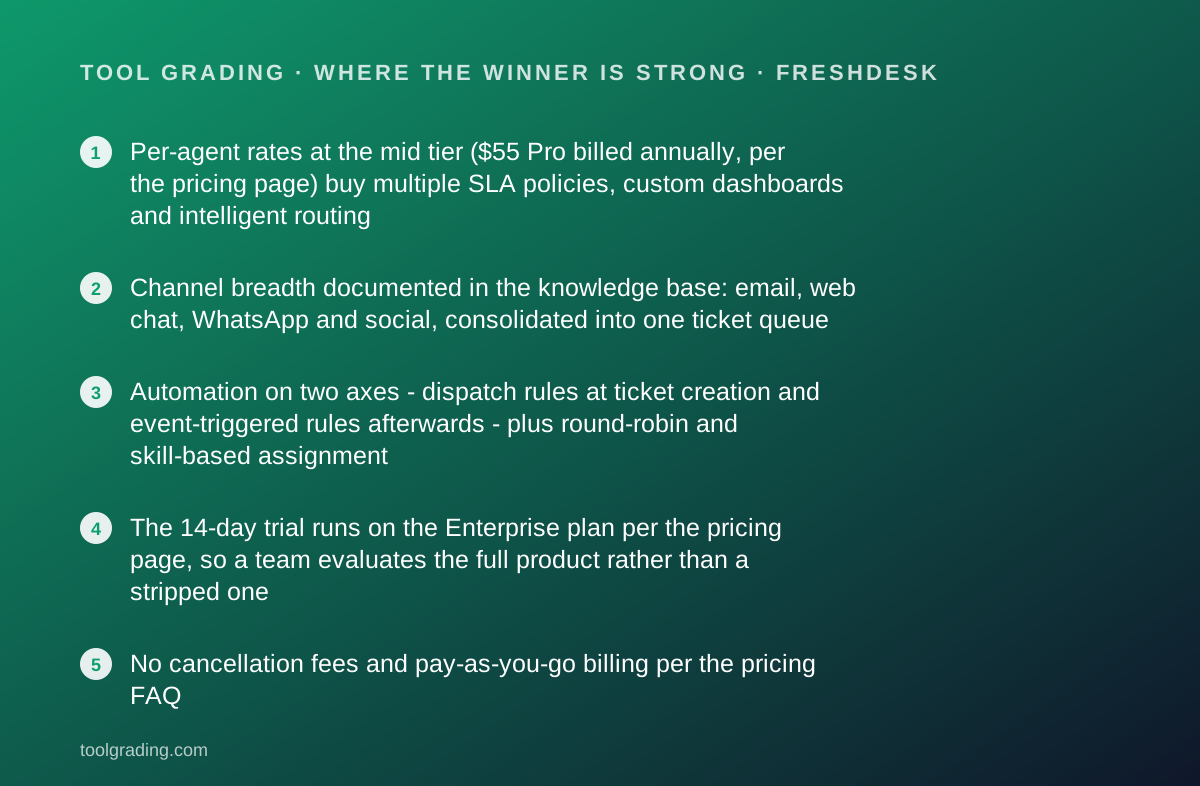
The argument is about where on the ladder the useful features sit. Both products are ticketing systems built on the same shape. Zendesk's plan documentation places SLA management and custom reports at Professional, its third tier. Freshdesk's pricing page places multiple SLA policies and custom dashboards at Pro, its second tier, at $55 per agent per month billed annually. For a team whose needs are contained in those features, the Zendesk review itself says a verified cheaper equivalent exists.
The counter-argument is ceiling. Zendesk's feature score of 4.6 is the highest on its page, built on a data model other systems are built on, the largest marketplace in the category, and a ladder that reaches multiple help centres, skills routing, a sandbox and custom permissions. A support operation that expects to grow from ten agents to a hundred will not have to migrate. That is a real advantage; it is just not the one a ten-agent team is buying.
How the two products are structured
Zendesk's data model has become the category's default, and the Zendesk review describes it from the developer documentation read on October 7, 2026: a single REST API over tickets, users, organisations and groups. A ticket carries a requester, status, priority, type, tags, custom fields, an assignee and a group, and a timeline of public replies and private comments. A user has a role, including a light agent role at some tiers. An organisation groups users and lets tickets inherit properties. Four mechanisms act on that model: triggers fire on ticket creation or update, automations fire on a timer, views are saved queries that make up the agent's queue, and macros are canned actions. The review's summary is that every help desk graded on this site is some simplification of those four things.
Freshdesk follows the same shape. A ticket carries status, priority, requester, assigned agent and group, properties, and a timeline of replies and internal notes, and every channel, email, portal, chat, WhatsApp, social and phone through the Freshworks telephony product, produces the same ticket object. The policy layer is SLAs with escalation, business hours and holiday calendars. The automation layer separates two axes that the documentation names: dispatch rules that act at ticket creation, and event-based rules that act when something changes. Round-robin distributes load; skill-based routing, at Enterprise, matches tickets to agent capabilities.
The structural differences are at the edges. Zendesk bundles messaging, voice, community forums and a help centre into the Suite, with multiple help centres from Growth. Freshdesk's phone is a separate Freshworks product, field service is a separate module, and its data model is less extensible than Zendesk's at the higher tiers. Freshdesk's Freddy AI layer is metered by session, 500 included on each paid plan and $49 per 100 above that, which makes self-service deflection a variable cost; Zendesk caps AI-powered answers at 50 on Team and 100 on Growth and sells further capability as add-ons.
For a ten-agent team the two models are functionally equivalent for the first year. The difference arrives when the team needs a second brand's help centre, a sandbox to test rule changes, or a data feed into another system, and at that point Zendesk's model is the one with the room.
Pricing for a 10-person team (as of October 2026)
Only Freshdesk carries printed figures on this page. Its pricing page was read on October 7, 2026, and all figures are per agent per month billed annually; monthly rates were not shown in the sections read. The page did not display a free tier, so the lowest paid rung is the floor, and the review advises a two-person team to confirm whether a free offering exists elsewhere before assuming.
Freshdesk for ten agents, with the review's model of eight queue agents, one lead and one administrator all on paid seats because no light agent role was documented: Growth at $19 is $190 per month or $2,280 per year, with ticketing, the knowledge base, pre-built reports and the AI agent's included sessions. Pro at $55 is $550 per month or $6,600 per year, with multiple SLA policies, custom dashboards, intelligent routing and a multilingual help desk, and is the realistic tier for a team with more than one customer class or a lead who builds reports. Enterprise at $89 is $890 per month or $10,680 per year, with skill routing, sandbox, audit logs and AI insights, which a ten-agent team rarely needs in year one. The trial runs 14 days on Enterprise with no card required per the FAQ; there are no cancellation fees.
Zendesk's structure, from the plan documentation read the same day: five Suite tiers, Team, Growth, Professional, Enterprise and Enterprise Plus, each per agent per month with annual and monthly options, and a narrower Support-only line documented separately. Light agents are documented on Growth, which would let the lead and possibly the administrator avoid full seats; on Team they are full seats. SLA management and custom reports arrive at Professional. The Zendesk review states that the vendor's rates have historically run above Freshdesk's at every comparable rung, and prints no figure because none was read.
The arithmetic that can be done honestly: Freshdesk delivers multiple SLA policies and custom dashboards for $6,600 per year at ten agents. Zendesk delivers the equivalent at Professional, its third rung, at a rate this site has not verified.
- Freshdesk Growth: $19 per agent per month billed annually; $2,280 per year for ten agents; ticketing, knowledge base, Freddy AI agent with 500 sessions (pricing page, October 7, 2026)
- Freshdesk Pro: $55 per agent per month billed annually; $6,600 per year for ten agents; multiple SLA policies, custom dashboards, intelligent routing
- Freshdesk Enterprise: $89 per agent per month billed annually; $10,680 per year for ten agents; skill-based routing, sandbox, audit logs
- Freshdesk AI sessions beyond the included 500: $49 per 100; no free tier displayed
- Zendesk Suite: Team, Growth, Professional, Enterprise, Enterprise Plus, per agent per month; SLA management and custom reports at Professional; light agents on Growth; prices not verified and not printed
Ease of use
Freshdesk leads, 4.2 against 3.9, and the gap is the administrator rather than the agent.
Both reviews make the same point about the agent surface: a ticketing system has a well-understood shape, and an agent who has used any help desk is productive within an hour. The Zendesk review goes further and says nothing on its page beats Zendesk at the agent surface; views are the queue, the ticket screen is the conversation, macros are the one-click actions, and users moving to other tools cite the agent experience as the thing they miss. Freshdesk's agent surface is described as comparable by verified reports from migrated teams.
The difference is what the administrator faces. Zendesk's trigger and automation model is expressive, and expressiveness has a cost: triggers fire in order, interact, and at scale produce behaviour that is hard to predict. The help centre is extensive on the subject, which the review treats as evidence that the subject needs explaining. The sandbox that makes experimenting safe is an Enterprise feature. The review's realistic picture for ten agents is live in a day, properly configured in a month, and best with one person who owns the rules permanently.
Freshdesk's two-axis automation model has the same failure mode at scale; verified reports describe rule interactions that are hard to debug once a team has thirty dispatch rules and forty event rules. But the onboarding section of the knowledge base covers connecting a support address, inviting agents, setting business hours and publishing a portal in order, and the review's picture is a day to be answering tickets and a week to have SLAs, groups and the first dozen rules in place, with no consultant. Portal customisation beyond templates needs someone comfortable with markup, and the Freddy AI setup is a separate configuration effort with its own metering to understand.
The 0.3 difference is a week against a month to a configuration the team can rely on. The Freshdesk review notes that at the comparable tier the two are roughly equal, and that Zendesk is heavier at the lowest tier, which is where a ten-agent team starts.
Feature depth
Zendesk leads, 4.6 against 4.1, and its 4.6 is earned on depth, ceiling and ecosystem rather than on any single capability.
The Zendesk review's inventory: a data model clean enough that other systems are built on it; triggers, automations, views and macros covering routing, escalation and agent productivity without scripting; multiple help centres on Growth, which multi-brand companies need and most rivals gate higher; skills-based routing on Growth, where Freshdesk places it at Enterprise; SLA management at Professional; custom reporting at Professional and real-time shareable reports at Enterprise; custom permissions and a sandbox at Enterprise; messaging and voice bundled; and AI agents included in capped quantities and extended by add-on. The developer surface is the deepest in the category, with a single REST API, an apps framework and the largest marketplace.
Freshdesk's 4.1 is a complete mid-market help desk with a ceiling below the enterprise products. What carries it: channel consolidation across email, chat, WhatsApp and social; SLA management with multiple policies at Pro; automation on both axes plus round-robin and, at Enterprise, skill-based routing; collaboration features to stop two agents answering one ticket; a multilingual knowledge base with portals and forums; custom dashboards at Pro; and single sign-on, audit logs and IP allowlisting at Enterprise. The AI layer is real and metered. What is thinner: the data model is less extensible, phone is a separate product, field service is a separate module, and reporting below Pro is pre-built only.
The cross-reading that matters for a ten-agent team: skills-based routing is on Zendesk Growth and Freshdesk Enterprise, while multiple SLA policies and custom reporting are on Zendesk Professional and Freshdesk Pro. Each product gates one commonly needed feature higher than the other, and the more common order of need, SLAs before skills routing, favours Freshdesk Pro. The 0.5 gap is the measure of everything Zendesk has above Professional that Freshdesk does not have at all.
Support and documentation
Zendesk leads narrowly, 4.0 against 3.9, and both scores are built the same way: strong self-service, tiered direct channels, and a discount for verified reports about the vendor's own support.
Zendesk's self-service is extensive: product documentation organised by component, a series of plan-type articles mapping features to tiers that the review calls a model of how a vendor should publish tier contents, and a developer site with API references. Direct channels are referenced without being mapped per tier in the sections read, and the vendor has historically sold premium support plans with named contacts and response commitments separately; the review advises confirming in writing what the intended tier includes. Verified reports describe direct support as competent for product questions and slow for account, billing and renewal issues, with larger accounts served better.
Freshdesk's support portal is organised by task across ticket management, channels, Freddy AI, onboarding, automations, portal setup, reporting, integrations and security, with articles current enough that documentation lag is not a recurring complaint. Direct channels are tiered in the familiar way, and the pricing page sections read did not state the mapping per plan. Verified reports are consistent that vendor support is uneven: responsive for product questions, slow for billing disputes and for integration problems needing escalation.
Both reviews name the same irony, a support software vendor whose own support draws the complaint. Neither publishes response-time commitments on the pages read and neither entry estimates them. The practical advice from both is identical: confirm what the purchased tier includes before relying on any channel.
What verified users report
Both reviews weigh public reports as evidence of pattern rather than measurement.
For Freshdesk, the dominant positive is value: a full help desk, channels, SLAs, automation and a portal, at a price that let users avoid the larger rival. Second is ease of setup, with small teams live in a day. Third is the automation model. The dominant complaint is vendor support. Second is AI metering, described as hard to forecast and as a surprise on the first invoice after a successful deflection campaign. Third is tier gating, with custom dashboards at Pro and audit logs at Enterprise the cited examples.
For Zendesk, the dominant positive is reliability and depth: a platform that scales from ten agents to hundreds without migration and can be made to do almost anything with triggers, automations and the API. Second is the agent experience. Third is the ecosystem. The dominant complaint is cost, and it is specific: the step to Professional for SLA management and custom reports, the AI add-ons, the premium support plans, and renewals negotiated upward. The second complaint is administrative complexity, with trigger systems that have grown beyond anyone's understanding and a sandbox gated at Enterprise.
The useful signal for a ten-agent team is that Zendesk's dominant complaint is about the exact step, Growth to Professional, that such a team must take to get SLA management, while Freshdesk's equivalent step, Growth to Pro, is a verified $36 per agent per month. Vendor support draws complaints on both sides and decides nothing.
Choose Freshdesk if / choose Zendesk if
Choose Freshdesk if the support team is two to fifty agents, the channels are mixed, and the team needs SLA policy and routing without an enterprise contract. Choose it if the need is contained in what Pro contains, multiple SLA policies, custom dashboards and intelligent routing at $55 per agent per month billed annually per the pricing page checked October 7, 2026, and will stay contained for a year or two. Choose it if forecasting the bill matters, because the seat price is verified and the only variable is AI sessions. Start on the 14-day Enterprise trial, decide which Pro or Enterprise feature is actually needed, and buy that rung. Do not choose it if the workflow needs custom objects and permissions at enterprise depth, if skills-based routing is needed before custom SLAs, or if a one- or two-person team was expecting a free tier the page did not display.
Choose Zendesk if the support operation is complex now or will be: multiple brands each needing a help centre, customer classes with distinct SLAs, skills across languages or specialties, and an engineering team that will build on the API. Choose it if buying for the next five years rather than the next twelve months, and plan for Professional, because the capabilities most teams consider basic are reached at the third rung. Plan for an administrator who owns the trigger model permanently. Do not choose it if the needs fit Team or Growth and will stay there, because the Zendesk review itself says a verified cheaper equivalent exists, and do not choose it without opening the live pricing page, because no Zendesk figure on this site has been verified.
The honest middle case is a ten-agent team that expects to be thirty agents with two brands in three years. That team is buying Zendesk's ceiling, and the question is whether to pay for it from year one or migrate later.
Bottom line
Freshdesk wins this comparison, 4.0 against 3.9 overall and 16.1 against 15.7 on the sum of sub-scores. It wins ease (4.2 against 3.9) and value (3.9 against 3.2), and loses features (4.1 against 4.6) and support (3.9 against 4.0). The axes it wins are the ones a ten-agent team pays for in year one, and that is the basis of the verdict.
The value comparison is deliberately incomplete. Freshdesk's rates are verified: $19, $55 and $89 per agent per month billed annually, per the pricing page checked October 7, 2026, which puts multiple SLA policies and custom dashboards at $6,600 per year for ten agents. Zendesk's rates could not be read and none are printed; its value score of 3.2 is a structural judgement that at ten agents the product's advantages sit mostly above the rung such a team buys. If the Zendesk page can be read and its Professional rate lands near Freshdesk Pro, the value gap narrows; the Zendesk review's own statement that its rates have historically run higher at every rung suggests it will not.
The feature comparison is not in dispute. Zendesk is the deepest, best-documented and most extensible ticketing platform graded on this site, and an operation that will need what sits above Professional should buy it and budget for it. A ten-agent team that will not should buy Freshdesk Pro and keep the difference.
Open both live pricing pages before signing. This is a documentation comparison, and no first-hand testing was run or is claimed.
Visit Freshdesk
We have no affiliate relationship with this vendor. Link goes to the official site.
Visit Zendesk
We have no affiliate relationship with this vendor. Link goes to the official site.