 Tool
ToolTrello vs Asana: the board you outgrow, or the tracker you grow into
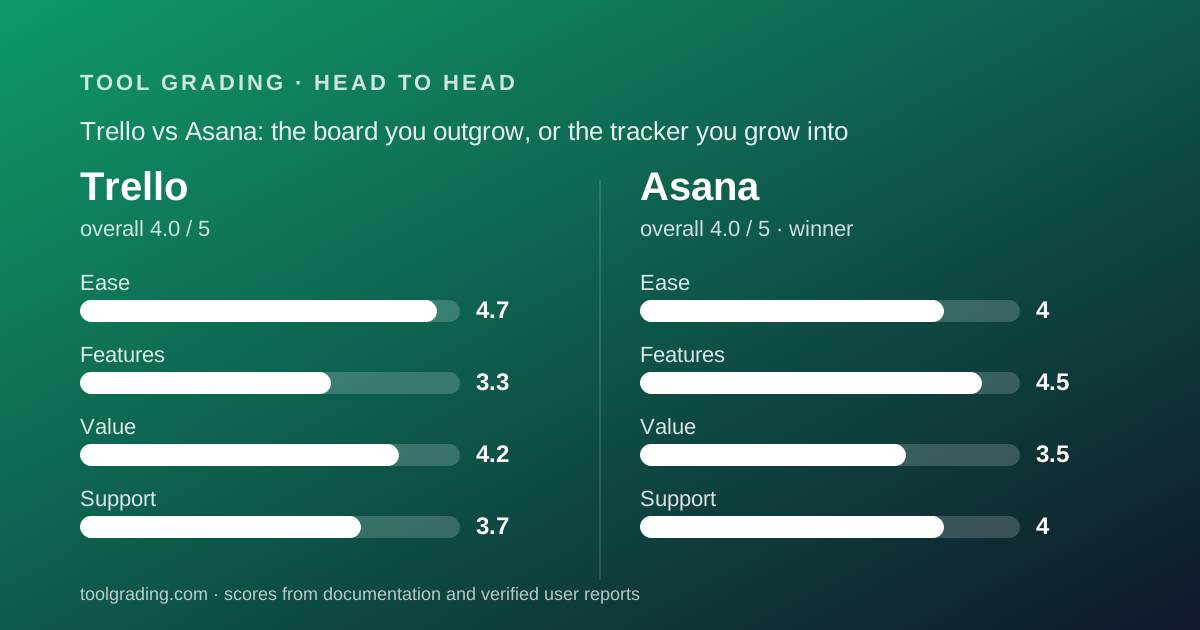
Trello and Asana both display 4.0 overall on this site, with Asana ahead on the sum of sub-scores by 16.0 to 15.9. Trello has the highest ease score in the category and the lowest feature score; Asana has the richer task object and a value score held down by per-seat pricing at the tier that contains its best features. Asana wins for a ten-person team with structured work. Trello wins on price and on speed to productive for a small team whose work is flat.
 4.0Asana
The short answer
This is a documentation comparison built from the two underlying grades on this site, Trello and Asana, and from the vendors' pricing pages as of October 2026; no first-hand testing was run.
The two products round to the same overall grade and are built on opposite bets. Trello scores 4.7 on ease, 3.3 on features, 4.2 on value and 3.7 on support, a sum of 15.9 rounding to 4.0. Asana scores 4.0, 4.5, 3.5 and 4.0, a sum of 16.0 rounding to 4.0. Asana is the winner on the unrounded sum and on the argument that follows, and the margin is as narrow as the rubric produces.
The argument is about how much the tool stores about the work. Trello stores a card in a list, and the list is the state; a card does not know, in a way the tool can act on, which other card it is waiting for or how it relates to a card on another board. Asana stores a task with an owner, a date, a parent, dependencies and custom fields, and every view renders that object. For flat work, Trello's thinness is the whole advantage: nothing to configure, nothing to learn, a whole team using it rather than a subset. For structured work, Asana's richness is the whole advantage: cross-project reporting that reconciles and a timeline that shows what is blocked.
The Trello review describes the typical sequence in verified reports: a board works beautifully for a year, then stops, and the team migrates to a heavier tool, Asana being the most common destination. This page is therefore less a choice between two tools than a question of where on that sequence a ten-person team currently sits, and whether it is cheaper to start where it will end up.
How the two products are structured
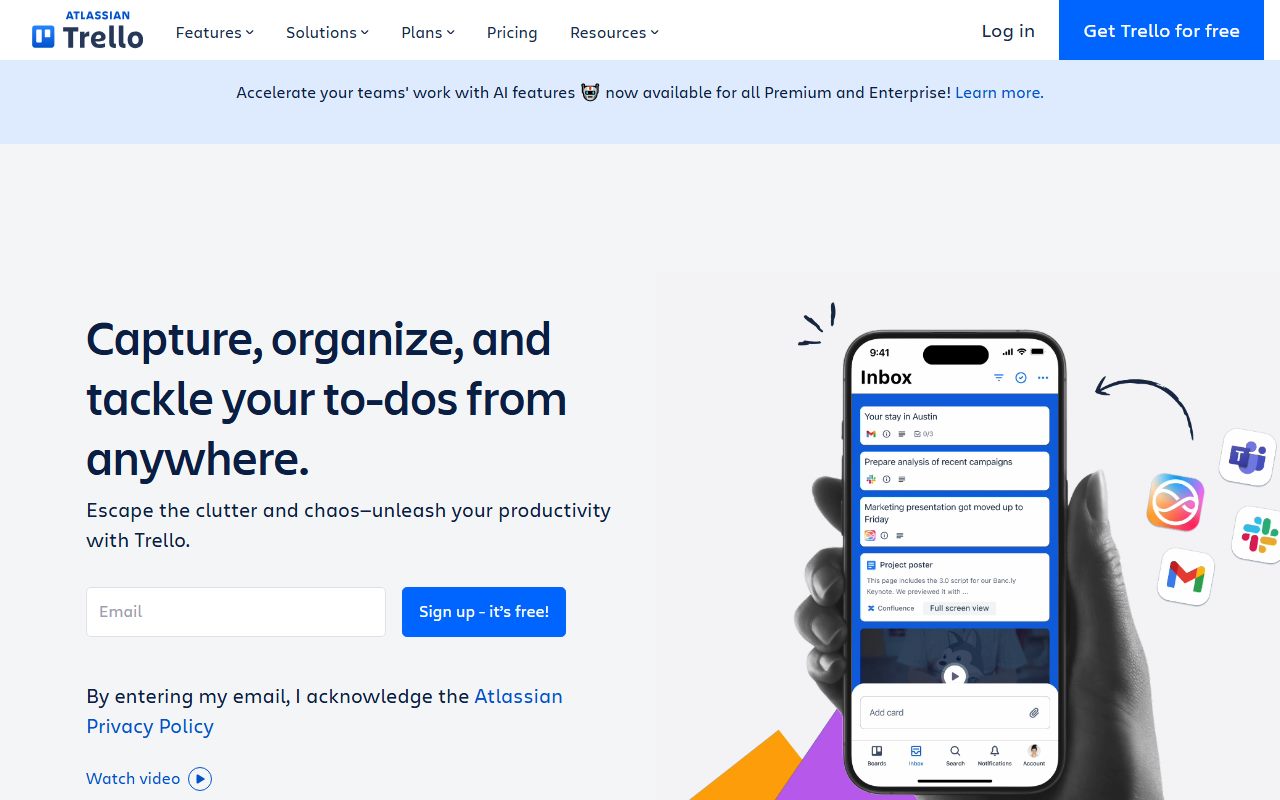
Trello's data model fits in one sentence, and the review on this site states it that way: a Workspace holds boards, a board holds lists, a list holds cards, and a card has a title, a description, members, labels, a due date, checklists, attachments and comments. There is no separate status field, no project object above the board, and no task object richer than the card. Everything added since, Power-Ups that bolt features onto a board, Butler automation that moves cards by rule, and the Premium views that render cards as a calendar, timeline or table, is an extension of the board rather than a replacement of it.
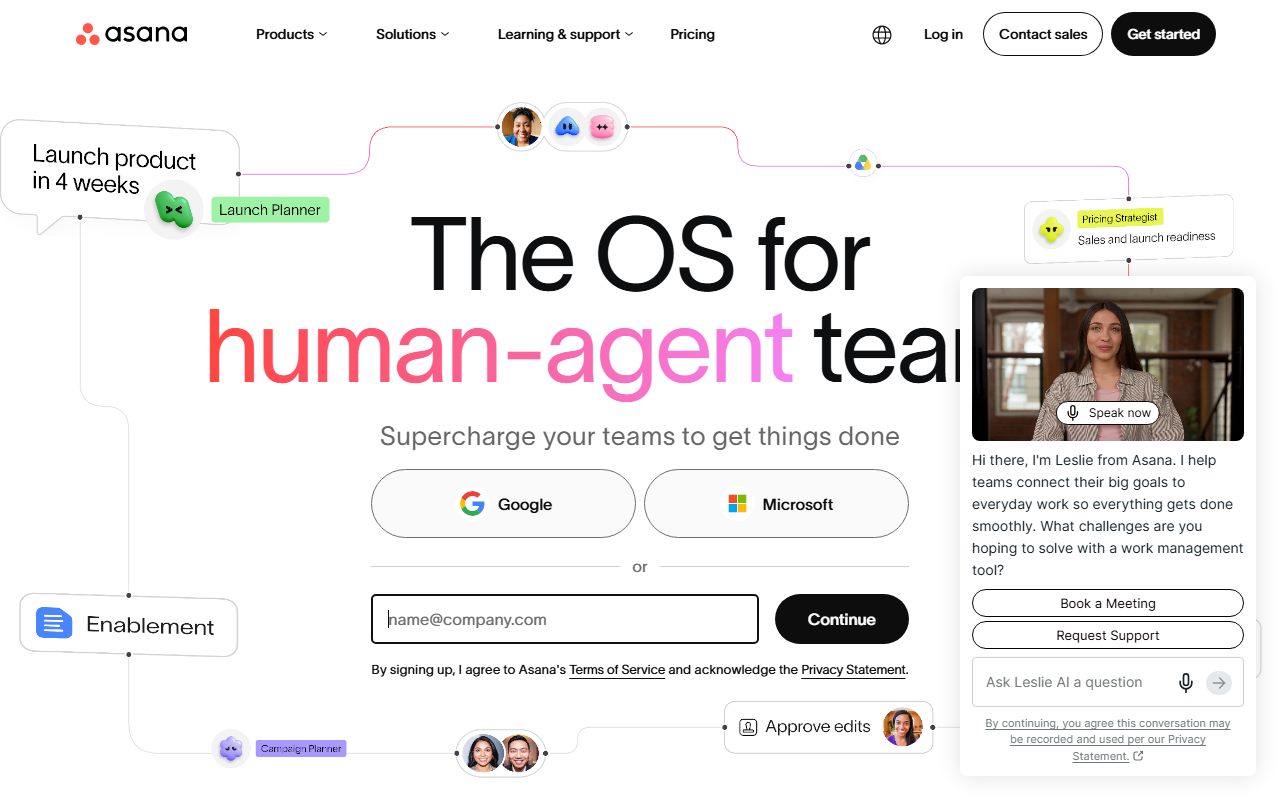
Asana's model is a task with an opinionated schema: one assignee, a due date, a parent project, optional subtasks, optional dependencies and optional custom fields. List, board, timeline and calendar are four renderings of that record. A board column in Asana is one property displayed as a lane, where a Trello list is the property itself. The Asana review draws the consequence: when a manager asks what is late across six projects, a tool that stores cards in columns has to be asked six questions, and a tool that stores task objects answers once.
The design stances follow. Trello's refusal to be more than a board is deliberate and the review credits it as honesty; the product is complete for its model and thin outside it. Asana's one-assignee-per-task rule is equally deliberate, and the review names it as a mismatch of model rather than a missing feature for teams with genuinely shared ownership. Neither stance can be configured away.
For a ten-person team the test is whether the work can be drawn as cards moving left to right on one board. If it can, Trello's model is sufficient and the extra structure of Asana is overhead. If drawing it needs arrows between cards, the Trello review's own decision rule says Trello is the wrong tool.
Pricing for a 10-person team (as of October 2026)
Trello's pricing page was read on October 7, 2026, and its figures are printed below. Asana's prices were not verified against the live page for its entry, and this site does not print a figure it has not checked, so Asana's pricing appears here as structure only.
Trello for ten users: Standard at $5 per user per month billed annually is $50 per month or $600 per year, with unlimited boards, custom fields, 250MB per file and 1,000 Butler command runs per month. Premium at $10 per user billed annually is $100 per month or $1,200 per year, and is the tier that contains Calendar, Timeline, Table, Dashboard and Map views, Workspace-level views across boards, and unlimited command runs. On monthly billing the same tiers are $60 and $125 per month. The Free tier caps a Workspace at 10 boards and 10 collaborators, 10MB per file and 250 command runs per month, which the review describes as a workable home for a very small team with flat work and a trial for anyone larger.
Asana's structure: a free tier with a seat cap, then paid tiers per seat per month with an annual discount. The step that matters is the first paid tier, because timeline, custom fields and reporting live there, which is to say the product's actual advantages live there. The per-seat rate at that tier sits at the higher end of the category, and per-seat billing applies to people who only need to read. Guest and comment-only arrangements exist and their terms change, so check the current plan before assuming stakeholders are free.
The comparison that can be made honestly: Trello Standard at $600 per year is the lowest paid figure among the tools reviewed on this site for ten people, and Trello Premium at $1,200 per year buys views that Asana includes at its first paid tier. Whether Asana's first paid tier costs more or less than $1,200 per year for ten seats is a question for the live pricing page, not for this entry.
- Trello Free: $0, up to 10 boards and 10 collaborators per Workspace, 10MB per file, 250 command runs per month (pricing page, October 2026)
- Trello Standard: $5 per user per month billed annually or $6 monthly; $600 per year for ten users; unlimited boards, custom fields, 1,000 command runs
- Trello Premium: $10 per user per month billed annually or $12.50 monthly; $1,200 per year for ten users; Calendar, Timeline, Table, Dashboard and Map views, unlimited command runs
- Trello Enterprise: $17.50 per user per month billed annually, Atlassian Guard Standard, 24/7 Enterprise Admin support
- Asana: free tier with a seat cap, then per-seat paid tiers; timeline, custom fields and reporting start at the first paid tier; figures not verified for the Asana entry and not printed here
Ease of use
Trello leads this axis by the largest margin on this page, 4.7 against 4.0, and its 4.7 is the highest ease score in the category on this site.
The Trello review builds the score from three nouns and the absence of required configuration. There are no required fields, no project hierarchy to define and no statuses to configure, because the lists are the statuses and the user names them by typing. The vendor's getting-started guide, readable for that review, is a nine-chapter walk from board basics to automation, and the first chapter is enough to be productive. Verified reports are unanimous that Trello is the easiest tool in its class to adopt and that the whole team uses it rather than a subset, which for a category whose main competitors suffer from partial adoption is a real advantage. The small discount is for the moment the model runs out, when a dependency or a cross-board view requires a Power-Up or a Premium view and simplicity becomes a set of workarounds.
Asana's score reflects a product that is pleasant immediately and useful only after a decision. Creating a project, adding tasks and assigning them needs no training; anyone is productive in an hour. But the tool will not decide what a project is in your organisation, which custom fields exist or what the statuses mean, and teams that let everyone improvise end up with reports nobody trusts. The review puts the cost at a week of one person's attention and credits the documentation with making that week possible without a consultant.
The gap of 0.7 measures time to a reliable configuration: minutes on Trello for flat work, a week on Asana for any work. What it does not measure is what happens after the first year, when Trello's simplicity has to be supplemented and Asana's structure starts paying back. The ease score is a day-one score on both products, and the Trello review is explicit that it does not penalise the tool for refusing to be something else.
Feature depth
Asana leads by an equally large margin, 4.5 against 3.3, and Trello's 3.3 is the lowest feature score in the category on this site.
The Trello score is built from the card, the Power-Ups, Butler and the Premium views. The card holds a title, description, members, labels, a due date with reminders, checklists with assignable items, attachments, comments and, at Standard and above, custom fields. There is no native dependency relationship, no time estimate or tracked time, and no parent-child beyond a checklist, where a checklist item is not a card. Power-Ups compensate, with unlimited Power-Ups per board on every tier including Free, but a Power-Up extends a board without changing the model, and a team relying on several for core function is building a tool out of parts. Butler can move cards, set dates and add members by rule within its quota. The Premium views are the only native way to see across boards.
Asana's score is carried by three capabilities that follow from the task object. Dependencies and timeline: marking that one task cannot start until another finishes and seeing the consequence on a dated timeline is exactly the capability the Trello card lacks. Rules and templates: moving a task to a stage can assign it, date it and notify someone, and project templates mean recurring work starts configured. Intake and reporting: forms create tasks with fields already filled, and portfolio views answer cross-project questions. What is thinner on Asana, documents and spreadsheet-like formulas, is thinner on Trello too, so the gap is not narrowed from that direction.
The 1.2-point difference is the largest on this page, and it is the price of Trello's 0.7-point lead on ease. The two numbers describe the same fact from two sides, which is what the Trello review says about its own grade. A team that will never need the features Asana has is paying nothing for not having them. A team that will need them in a year is deferring the cost, not avoiding it.
Support and documentation
Asana leads, 4.0 against 3.7, and both scores are held by the same thing: direct channels below the enterprise tier.
Trello inherits Atlassian's support shape. Self-service is good and proportionate: the nine-chapter getting-started guide, a remote-work guide, webinars, Atlassian's support portal and developer documentation for Power-Ups. A product this simple does not need a large documentation set, and the set it has is current. Channels are where the score is held: the pricing page names channels explicitly only at Enterprise, where it lists 24/7 Enterprise Admin support, and below that support runs through Atlassian's portal and community, which verified reports describe as adequate for account questions and slow for anything else. Atlassian maintains a public status page covering Trello.
Asana's self-service is the strong part; the review calls the help centre and training material thorough, current and written for someone trying to do a job. For a product whose main risk is being configured badly, that documentation prevents the most expensive failure mode, and an active community forum often answers configuration questions faster than a ticket. Channels follow the category ladder, and the review advises verifying what the purchased tier entitles you to.
The 0.3 difference reflects that Asana's documentation has more work to do and does it, while Trello's has less to do and does enough. Neither entry estimates real-world response time.
What verified users report
Both reviews weigh public reports as pattern rather than measurement, and the Trello pattern is among the most stable in the category because it has accumulated over many years.
For Trello, the dominant positive is simplicity: onboarding a whole team in an afternoon and never having to explain it. Second is price, particularly Free for very small teams and Standard for small businesses. Third is reliability. The dominant complaint is the ceiling: the moment the work needed dependencies, cross-board visibility or reporting, the Power-Ups and workarounds that followed, and the migration. Second is view gating, with Calendar and Timeline at Premium cited as the reason for an otherwise unnecessary upgrade. Third is notification volume on busy boards.
For Asana, the dominant positive is clarity of accountability, the direct consequence of the single-assignee rule. The dominant complaint is price at scale, per-seat cost multiplied by people who only need visibility, and it is the most frequently reported reason for leaving. Second is notification volume. Third is the absence of native time tracking at lower tiers.
The two patterns connect. Trello's dominant complaint ends in a migration, and Asana is the tool the Trello review names first as the destination. Asana's dominant complaint is what the migrating team meets on arrival. A ten-person team should ask which complaint it would rather have: a tool that is too small, or a tool that is too expensive for its readers. Notification noise appears on both sides and decides nothing.
Choose Trello if / choose Asana if
Choose Trello if the team's work is flat: a content pipeline from idea to published, a hiring funnel, a support queue, a simple client-delivery board, a to-do system for a team of two to twenty. Choose it if the team would resent spending a week configuring anything and if the whole team using the tool matters more than what the tool can do. Choose Standard at $5 per user billed annually, per the pricing page checked October 7, 2026, as the tier most small teams need; buy Premium only if the Calendar, Timeline or Dashboard views are genuinely required, because at $1,200 per year for ten people it is priced like a fuller tool. Do not choose Trello for dependency-heavy or cross-project work, and do not plan to stay on the Free tier with more than a handful of boards or collaborators.
Choose Asana if the work has discrete tasks with single owners and dates that matter, and if some tasks cannot start until others finish. Choose it if someone will own the configuration for the first fortnight, if the team has outgrown a board and the specific symptom was not being able to see what is blocked across projects, and if the paid tier can be justified for everyone who needs a working seat. Do not choose it on the strength of the free tier, which omits the three things the product is best at, and do not choose it if most intended users only need to read or if the work genuinely has shared ownership.
The honest middle case is a team currently on Trello whose boards have multiplied. The Trello review's own sign is that the migration is not a failure of Trello; it is Trello being used past its design. If the arrows between cards have started appearing in card descriptions, the migration has already begun, and the cheaper decision is usually to make it on purpose.
Bottom line
Asana wins this comparison by 16.0 to 15.9 on the sum of sub-scores, with both products displaying 4.0 overall, and the winner is chosen on that sum and on the structural argument rather than on any single axis. The axes split cleanly: Trello wins ease (4.7 against 4.0) and value (4.2 against 3.5), Asana wins features (4.5 against 3.3) and support (4.0 against 3.7). That is a tie by count and a narrow win for Asana by magnitude, and the magnitude is on the axis that matters most in year two.
Trello is the best board graded on this site, and the cheapest paid tool for ten people at $600 per year on Standard, per the pricing page checked October 7, 2026. A team whose work is flat gets excellent value and should not be talked into more. The Trello review's grade is for a tool that does one thing well and should not be bought for anything else, and this page agrees.
Asana is the tool the Trello users migrate to, and it costs more per seat at the tier that contains its advantages, with figures that were not verified for its entry and are not printed here. For a ten-person team whose work has structure, buying it first avoids a migration that verified reports describe as arriving within a year or two. For a team whose work does not, it is a slower to-do list at a higher price.
The decision rule from both reviews holds: choose the tool whose data model matches the shape of your work. Open the live pricing pages of both vendors before signing. This is a documentation comparison, and no first-hand testing was run or is claimed.
Visit Trello
We have no affiliate relationship with this vendor. Link goes to the official site.
Visit Asana
We have no affiliate relationship with this vendor. Link goes to the official site.